
Archives on the move
Novel Mayan cultural artefacts can illustrate how indigeneity crosses borders. Books in brief: Indigenous Archives: The Maya Diaspora and Mobile Cultural Production
Indigenous Archives: The Maya Diaspora and Mobile Cultural Production, Floridalma Boj Lopez, 2026 Duke University Press
The paradox of being Maya—rooted in ancestral territory for millennia yet hypermobile due to migration flows—is at the heart of this book about how indigeneity travels across borders.
In an examination of how cultural artefacts among the Maya diaspora within the US represent a key archive of collective memory, Floridalma Boj Lopez draws attention to how recollections of Guatemala’s civil war can shed light on the violent experiences of migration.
That is because the very quality of being Maya, rooted yet mobile, illustrates a fluid relationship to the racial categories that are at the heart of Latinidad and indigeneity in the US.
She writes: “As migration also represents dispossession from an ancestral relationship to specific territories, looking at material artifacts offers a distinct way to conceptualise the continuity that exists alongside deep disruptions.”
It is an important observation in the case of the Maya, who began migrating to the US as a direct result of either outright genocide or generational poverty resulting from virulent racism.
Moreover, demographic data that distinguishes between Maya and Ladino Guatemalans, for example, is all but non-existent, greatly complicating Maya visibility.
Boj Lopez adopts a fascinating but logical premise: the journey of migration often requires bringing only what one can carry.
While the things that migrants carry have a story to tell, that story is less about their episteme as indigenous people and more about their knowledge as migrants attempting to survive a militarised border landscape.
As a result, the children of Maya migrants often grow up lacking family heirlooms or land rights and hence, within this context of indigenous dispossession, what materials do the Maya travellers keep to tell their stories?
She considers the “mobile archives” of indigeneity of Mayas in cities such as Los Angeles expressed collectively in economic and geographic spaces where they gather to maintain community ties and practices.
These allow Mayas to engage with each other in cultural vernaculars as they circulate within colonial settler societies that benefit from their erasure or silence as indigenous subjects.
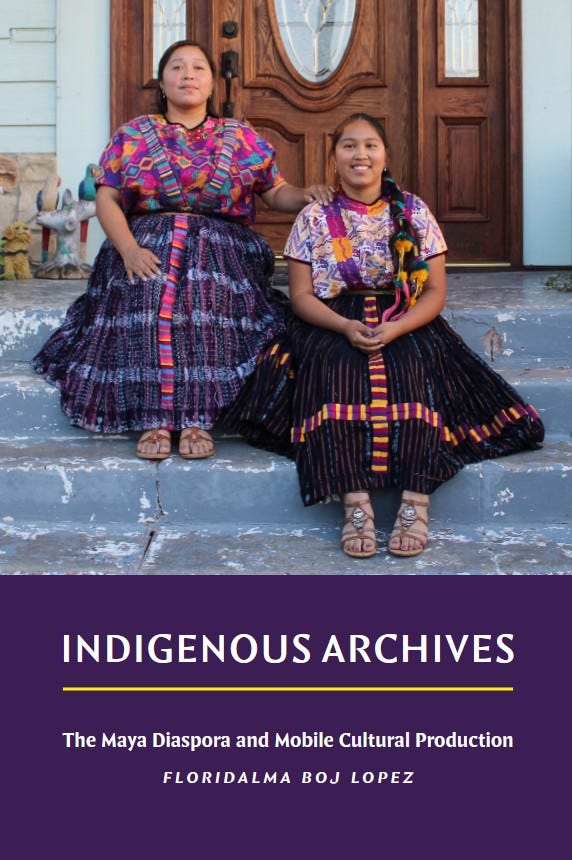
The author writes: “When a teenager who is born and raised in Los Angeles wears her great-grandmother’s corte (skirt), she is literally wearing an archive shaped by her ancestors in the cosmological sense and also by her elders who made decisions throughout their lives to maintain certain practices and keep these textiles—which are instances of vibrant Indigenous social relations.”
She argues that Maya intergenerational relationships are disrupted when indigenous migrants in the US are exposed to the logic of settler colonialism.
Mobile archives of indigeneity such as clothing can be valuable epistemologically for linking the historical struggles of Maya people and the contemporary diaspora.
Textiles function as a cultural record because they can document and transmit geographic, gendered, and class histories across generations.
Young adults of Maya descent in the diaspora, however, engage new forms of cultural production to respond to the overlapping racial regimes in the US, adding great importance to intergenerational relationships within the community.
One outcome of this can be new ways to confront the existence of transnational racism and expressions of the flexible nature of new and old forms of cultural practice.
BUY THIS BOOK: UK/Europe ——— USA/Americas