
Armageddon foreseen
Was a masterpiece by Mario Vargas Llosa about the Brazilian ‘War of Canudos’ really referring to Israel’s rampage through the Middle East?
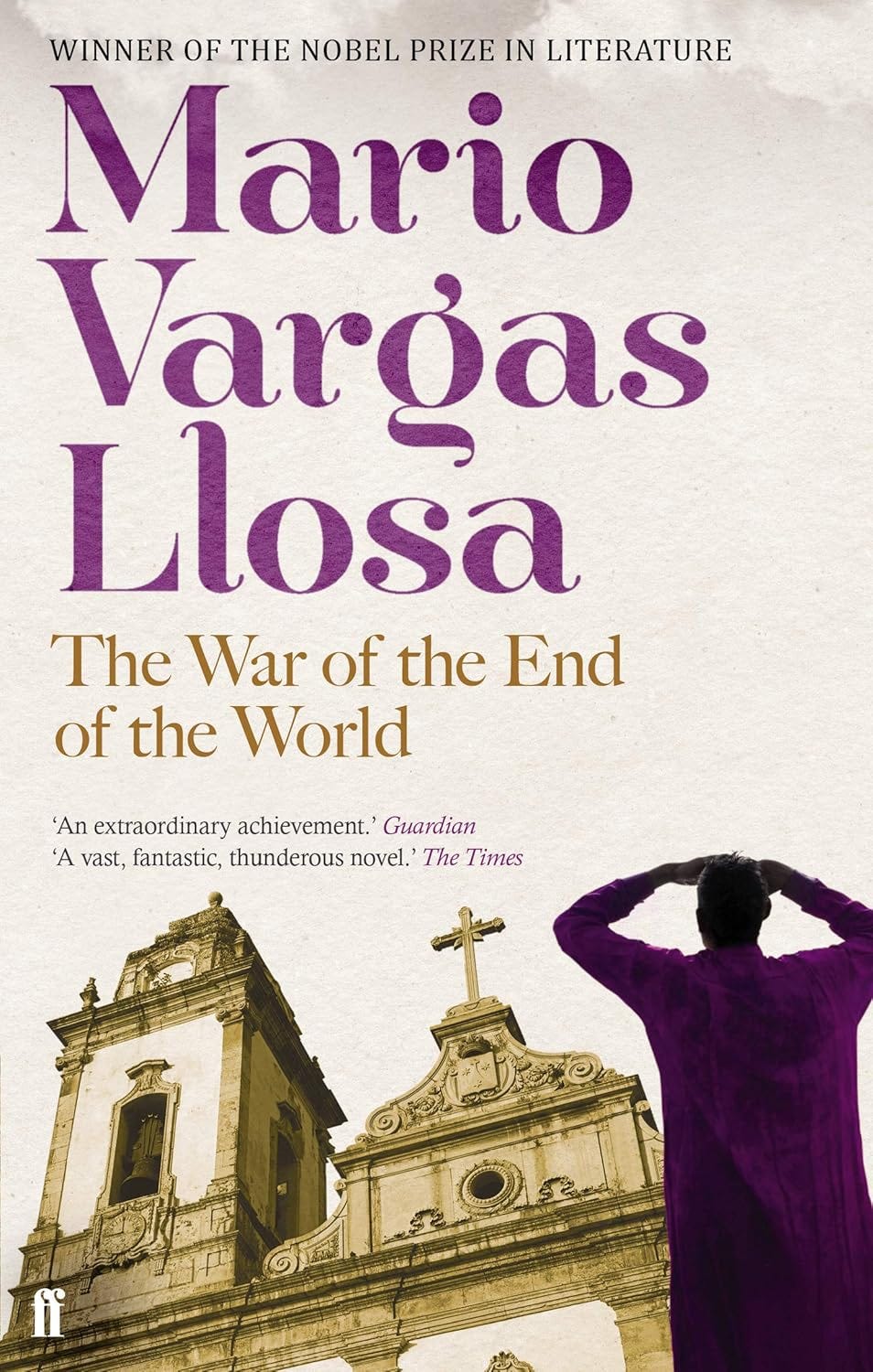
The War of the End of the World, Mario Vargas Llosa, translated by Helen Lane, 1985, Faber & Faber (1981, Seix Barral)
By Gavin O’Toole
A predictably oversensitive examination in 2021 of Mario Vargas Llosa’s relationship with Israel asked whether Peru’s most celebrated author was any longer a “great friend” to the Jews.
This question reflected a thin-skinned reaction to his obdurate criticisms of mistreatment of the Palestinians and a myopic exasperation at the fact that a literary titan could hold anything but favourable views of Israel.
The truth is that although Vargas Llosa was a conservative, his anger at the persecution of the Palestinians—especially ethnic cleansing through settler violence—was consistent.
It is not that the Nobel laureate was no longer enamoured of Israel—whose intellectual establishment initially lionised him for his loyalty, rewarding him with the Jerusalem Prize in 1995—but of its political establishment.
While a conflict began to set in following the Oslo accords—fascination for things Jewish, yet growing disillusionment with the Israeli government, especially under Benjamin Netanyahu—Vargas Llosa remained a committed Judeophile.
Yet the Peruvian was not prepared to remain silent about Israeli crimes, conceding the country’s right to self-defence against Hamas while remaining sharply critical of the scale and nature of the massacre in Gaza.
What changed, then, was not Vargas Llosa, but Israeli and indeed broader Jewish tolerance of criticism by influential public figures about this state’s right-wing, ultranationalist and very violent metamorphosis, the consequences of which we are witnessing in vivid detail today.
Writing in 2016, Vargas Llosa put it thus: “From the moment I first set foot in Israel in the middle of the 1970s, I felt a great affection for this country … So it causes me great pain to see local public opinion becoming increasingly intolerant and reactionary—which is the reason that the country has the most nationalistic and religious government in its entire history, with increasingly less democratic policies. To complain about them and to criticise them is not only my moral duty, it is an act of love.”
Indeed, Vargas Llosa had always been explicit about what he regarded as his debt to Jewish writers, especially the liberal intellectuals opposed to authoritarianism he marshalled in The Call of the Tribe, such as Friedrich von Hayek, Karl Popper, Raymond Aron and Isaiah Berlin.
He had even chosen to make his ostentatious repudiation of Marxism as what he claimed was a source of tyranny in a high-profile lecture to the Latin American Jewish Congress.
His novel The Storyteller—a sensitive exploration of ethnicity, memory and myth—is built sympathetically around the character of a Jewish ethnologist Saúl Zuratas.
While it might be natural to revisit this book—published in English in 1989—to gain an insight into Vargas Llosa’s perspective on Judaism, the story is only a tangential exploration of Jewishness.
The ethnologist Zuratas abandons scientific research to become a storyteller for an Amazon tribe in an effort to help them form a repository of ancestral memory, while also healing what ails his own identity as a Jewish Peruvian.
This is a tale about cultural hybridism and the role played by storytelling within it, the defence of minorities, and a challenge to stereotypes of Jews in an arch-Catholic country.
A more instructive work, politically at least, was, Israel-Palestine: Peace or Holy War, published after a trip to Israel in 2005 that condemned Israeli practices and spoke out about the suffering of Palestinians.
Yet by then this book-length essay could merely tell us what we knew already about Vargas Llosa’s anger at the treatment of the Palestinians, with the prominence it gained causing immediate unease among many Israelis.
Vargas Llosa was also a leading force behind a book of essays published in 2017, Kingdom of Olives and Ash, to mark 50 years since the six-day war in 1967, when Israel first entered the Palestinian territories.
But perhaps the most important book that he may have written with Israel in mind is one that has never been considered in this light, yet is a classic: The War of the End of the World, first published in the original Spanish in 1981 and in English translation in 1984.
The novel contains significant and disturbing parallels with what has unfolded in the Middle East in the last 40 years and it is hard to believe that when writing it Vargas Llosa was not thinking about Israel in large part.
By then, he had visited Israel twice, firstly in 1974 and then in 1977 to speak at a conference organised by the Hebrew University of Jerusalem while serving as president of the writers organisation PEN International.
Set in 19th-century Brazil, The War of the End of the World is a fictionalised account of the apocalytpic “War of Canudos” in Bahia that explores themes of religious fanaticism, ideological polarisation, and the clash between secular authority and messianic extremism.
Vargas Llosa’s first historical novel, and his first set entirely in a country other than Peru, marked a break in both style and focus with its gaze on universal human tendencies of intolerance and dogmatism. It was considered by the author to be his most difficult to write.
The Canudos conflict was stoked by the Brazilian Republic’s response to a millenarian cult led by Antônio Conselheiro around 1874, and the novel depicts a destructive tension within a nascent state between secular governance and groups motivated by religious law.
The “Counsellor” at the heart of the story leads a community of outcasts through apocalyptic prophecies and a rejection of the state, mirroring today’s Israeli far-right and settlers who instrumentalise religion to justify political goals or frame their struggle as existential.
The Canudos conflict itself involved a superior military force struggling to suppress a deeply committed, decentralised resistance in harsh terrain, reflecting the IDF’s ambition of “total victory” against non-state actors driven by ideology not military strength.
Crucially, Vargas Llosa highlights how politicians, journalists and revolutionaries all distort reality to fit their own visions, a hallmark of Israeli and US discourse where events are presented through polarised frameworks of victimisation or security.
The character of the near-sighted journalist is a particularly apt metaphor for how western media have packaged the conflicts stoked by Israel. The journalist views the struggle through a rigid ideological lens, presenting the rebels not as they are but as part of a global conspiracy that fits his own view of the world.
It is only when he loses his spectacles—the filter through which his reality has been constructed—that he begins to see both the full consequences of war but is, in effect, also dazzled by the resulting trauma. Eventually, the truth dawns and the journalist will begin to document the true horror of this conflict when, of course, it is too late.
There is a striking set of parallels in this novel between Israeli military excess and Palestinian resistance. The inhabitants of Canudos were so numerous, artful and determined in their opposition to the Brazilian army that it took four campaigns to defeat them, the first three of which resulted in failure.
The fourth and final expedition brought the war to a bloody conclusion in October 1897 when a massive federal force was deployed with the most modern armaments to bombard and overwhelm the rebels.
The only way to bring this troublesome rebellion to an end once and for all was to eradicate nearly all who remained—a massacre of breathtaking proportions comparable to genocide. By the end of the conflict, 30,000 people had died.
While on the surface this is a story about Brazil, Vargas Llosa started writing it while in Britain before visiting the South American country, and in his prologue to the book made reference to the portentous carnage of the American Civil War.
Publishers’ Weekly wrote that “this epic historical novel tackles religious, political, and moral ideologies that seem even more relevant in today’s rocky post-millennium climate”.
But if The War of the End of the World could, therefore, be about anywhere—the parallels are too numerous and too uncomfortably close to say definitively, given Vargas Llosa’s most passionate cause célèbre, that it is not, in fact, about Israel.
BUY THIS BOOK: UK/Europe ——— USA/Americas