
Asymmetric wordfare
Iran’s ties with Latin America have been distorted by US and Israeli narrative terrorism. We review titles about the Islamic Republic's engagement with other targets of imperialism
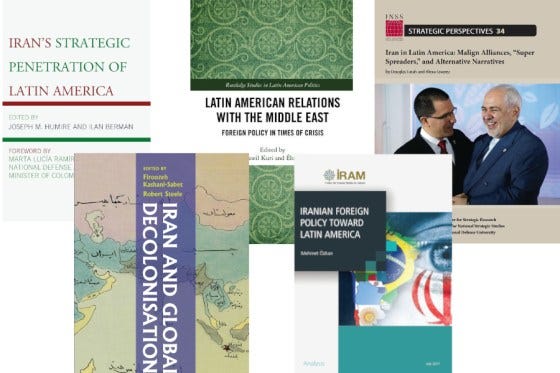
Iran’s Strategic Penetration of Latin America, Ilan Berman and Joseph M Humire (eds), 2016, Lexington Books
Iran in Latin America: Malign Alliances, “Super Spreaders”, and Alternative Narratives, Douglas Farah and Alexa Tavarez, 2021, Institute for National Strategic Studies/National Defense University Press
Iranian Foreign Policy toward Latin America, Mehmet Özkan, 2017, Center for Iranian Studies, Ankara
Latin American Relations with the Middle East: Foreign Policy in Times of Crisis, Marta Tawil Kuri and Élodie Brun (eds), 2022, Routledge
Iran and Global Decolonisation: Politics and Resistance after Empire, Robert Steele and Firoozeh Kashani-Sabet (eds), 2023, University of Chicago Press
If the illegal aggression unleashed by Israel and the US against Iran is likely to be highly asymmetric, then so are their narratives seeking to justify it.
That is because Tehran’s appeal to anti-imperialism and resistance against self-evident global tyranny pushes at an open door across the developing world.
Nowhere is that more so than in regions similarly subject to the falsehoods of US-Israeli neocolonial interference such as Latin America.
Progressive governments there have sought to build constructive ties with Tehran on the basis of a shared rejection of American hegemony, lies, and bad faith.
However, prepare for an unprecedented barrage of distortions about Iran in the transatlantic corporate media and from puppet governments that takes aim at these ties.
Just as Donald Trump’s objective in employing the ruse of “talks” with Iran was from the outset a pretext to prepare for a war of choice, Washington has been laying the groundwork to build the discourses now being used to justify its unparalleled aggression.
Complicit western media often tells us about Iranian “proxies” throughout the Middle East, from Hezbollah to Hamas, but we are rarely informed about the narrative proxies controlled by the US and Israel to poison minds throughout the Americas and beyond.
Those proxies are well represented among the authors of books and studies published in the last decade about Iran’s relations with Latin America, where it has sought to find common cause in its resistance to US-Israeli imperialism.
Nonetheless, a survey of titles reveals both that the narratives of imperialism are not universally accepted while also highlighting the main themes of these western obsessions.
Before we look at those titles, however, it is worth reflecting on Iranian-Latin American relations to date, and their importance to US strategic calculations.
These have been an important aspect of Tehran’s foreign policy in the search for natural allies against imperialism but have also informed the new US foreign policy towards Latin America under a revived Monroe Doctrine.
The potential for alliances was clear in the wake of last June’s attack on Iran by Israel and the US, when several countries took partisan approaches that did not swallow the Israeli-US lies—not least Venezuela, Bolivia, Cuba, Chile, and Brazil, all of which condemned Israel or the US, or both, but not Iran.
It was only Argentina under its far-right—and arguably deranged—President Javier Milei, an irrational ally of Israel, that publicly sided with the Jewish state, calling Iran “an enemy of Argentina”.
This diversity in reactions reflect the uneven and limited footprint Tehran has in Latin America, whereby its strongest ties are with countries whose governments share an ideological hostility to US hegemony.
Another key area of convergence is on nuclear weapons: Latin America has a long history of advancing non-proliferation and, despite incessant lies by the US and Israel, Iran’s nuclear ambitions relate solely to civilian power.
In concrete terms, Iranian-Latin American relations are limited to trade and military exchanges. Brazil is Iran’s biggest regional trade partner—mostly due to Brazilian agro-exports—and until recently Iran was helping Venezuela to evade illegal US sanctions on its oil exports.
Iranian naval vessels have made symbolic visits to Latin America, including a trip in 2023 during which Iranian warships docked in Brazil and traversed the Panama Canal.
In recent years, Iranian officials have also signed agreements with Bolivia, Cuba, and Nicaragua to supply hardware such as reconnaissance drones and river boats or to cooperate in areas such as cybersecurity and military training.
Some analysts have also argued that Tehran has promoted a model of militia and paramilitary operations in the region based on an understanding of asymmetric warfare to resist foreign intervention.
Ties with Latin America have been bookended by Iran’s relationship with revolutionary Venezuela, initially forged through a series of state visits between 2005 and 2007 by President Hugo Chávez and Iran’s then President Mahmoud Ahmadinejad.
The two countries developed trade and security cooperation through annual bilateral summits and last year Iran was working on finalising a bilateral trade deal that is probably unlikely to survive the recent turmoil.
Iran reportedly maintained a drone manufacturing facility on a Venezuelan air base where it also trained staff to operate the equipment.
Nonetheless, the cornerstone of the relationship was the help Iran gave to the Maduro regime to evade US sanctions, which in turn led to increased cooperation in oil production.
The US raid to kidnap Nicolás Maduro and seize control of Venezuela’s oil in January immediately curtailed strategic ties, and has turned the country into a new arena of confrontation with Iran.
Washington’s playbook has been familiar, with officials and academic proxies building a narrative over years on the basis that any Iranian influence in Latin America—and particularly Venezuela—is a threat to US national security.
It is quite clear from the ease with which the US seized Maduro and Venezuelan oil that such narratives exaggerating national security threats to America are mendacious.
Those Iranian-designed drones and missiles said to be in the possession of Venezuela’s forces obviously proved to be useless in strengthening its ability to deter US pressure.
To bolster the official US narrative, complicit “experts “ and journalists have aimed to link illegal migration and drug trafficking to alleged Hezbollah networks run by Iran.
A key recurrent theme in US- and Israeli-led narrative demonisation of Iran’s activity in Latin America has been reports claiming that Hezbollah is operating jihadi cells and training guerrilla groups in the region.
Israel and the US have alleged—without evidence—that Venezuela’s relationship with Iran is at the root of this activity.
The foundation of such claims is the allegation that Hezbollah was behind the 1994 bombing of the AMIA Jewish community centre in Buenos Aires that left 85 dead.
Since the start of the Gaza war in 2023, reports have also suggested that Latin American intelligence agencies have “thwarted” several terrorism plots allegedly linked to Hezbollah.
Argentina’s Milei has been more vocal than any other leader about Hezbollah, with his security minister claiming the group is present in Bolivia, Chile and the tri-border area between Argentina, Brazil, and Paraguay.
Such claims provide an example of the threat narratives that recur in books and reports published in the US about Iranian relations with Latin America.
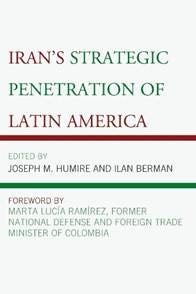
Iran’s Strategic Penetration of Latin America edited by Ilan Berman and Joseph M Humire, for example, argues that Iran’s regional advance in America’s “own hemisphere” represents an intrusion with significant national security implications for the US and its allies.
The editors and contributors contend that Iran has been leveraging anti-US sentiment in the region to expand its influence in the western hemisphere.
Not surprisingly, the editors parade their expertise as leading thinkers on this topic, and how they have been consulted, for example, by such agencies as the CIA well as the US departments of defence and state.
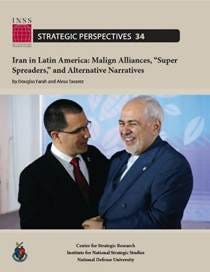
A similar work, Iran in Latin America: Malign Alliances, “Super Spreaders,” and Alternative Narratives by Douglas Farah and Alexa Tavarez is what you might expect from the US Institute for National Strategic Studies.
It advances an alarmist argument that greatly exaggerates Iran’s ability “to shape the information environment and spread the narrative of the United States as an imperialist force perpetrating violence and instability in Latin America”.
The authors assert that what they claim are “ongoing and multifaceted campaigns of disinformation and carefully curated messages” are coordinated with Russian and Venezuelan state media companies and thousands of allied internet and social media accounts.
Together, these efforts pose a strategic challenge to both US interests and regional efforts to promote stability, democratic values, and the rule of law.
However, alongside such loaded national security narratives are far more nuanced and balanced works.
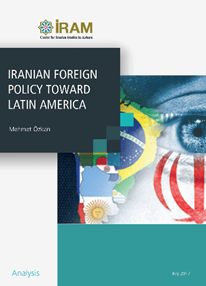
An objective assessment of Iran’s growing relations with the region can be found in Iranian Foreign Policy toward Latin America, published in 2017 by the Center for Iranian Studies (IRAM) in Ankara.
The author, Mehmet Özkan, is a professor of international relations in the Joint War Institute at the National Defence University in Istanbul.
He explores changing relations between Iran and Latin America that started in the period of Ahmadinejad and gained rapid momentum before slowing down thereafter.
As a result, he points to factors that represent obstacles to Iran’s efforts to seek legitimacy—not least the vacillations of Latin American politics as it swings from left to right and back again.
The main problem for Iran, therefore, is not so much how it can expand its field of legitimacy in a region undergoing political transformation, but whether it can do so at all.
Özkan’s study gives the lie to the US national security establishment’s portrayal of Iran as a competitor for regional influence, and paints a much more realistic picture of the real obstacles it faces in such a distant and complex region.
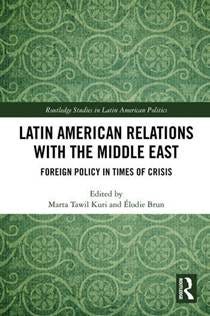
A valuable academic source of context can be found in Latin American Relations with the Middle East: Foreign Policy in Times of Crisis, edited by Marta Tawil Kuri and Élodie Brun.
This explores the relations of ten Latin American states with Middle Eastern countries and, while the focus is not specifically on Iran, provides expert insights on the forces driving diplomacy.
Contributors seek to examine Latin American and Caribbean foreign policies towards the Middle East in four areas: diplomatic attention; trade and investment; development cooperation; and security matters, intelligence, and the relationship with multilateralism (a theme within which Iran figures more prominently).
Its empirical focus and willingness to portray Latin America as a subject in these relationships is both refreshing but also a direct intellectual challenge to the doctrinaire and ideological national security obsession evident in US establishment narratives on Iran.
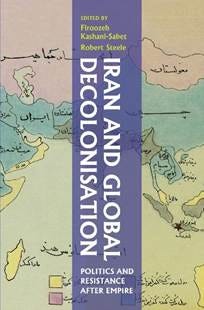
A valuable counterpart to this inherently Latin Americanist perspective is Iran and Global Decolonisation: Politics and Resistance after Empire, edited by Robert Steele and Firoozeh Kashani-Sabet.
This investigates from the Iranian perspective another theme of overlap with the Latin American experience—colonialism and decolonisation.
During the final decades of the Shah’s rule in the late 1970s, Iran sought to establish close relationships with newly independent counterparts in the Global South, and most scholarly work focused on this period has dwelt upon the Cold War and Iran’s relations with the US, Russia, and Europe.
However, as the editors point out, little attention has been paid to how the country interacted with other regions, such as the Americas.
This study therefore contributes to theoretical debates around the re-shaping of the world brought about by decolonisation.
Again, if its main focus is not Latin America (Fernando Camacho Padilla’s chapter is the only one directly about Iran’s relations with the region, and that is during the Pahlavi period), this collection does at least consider how Iran’s own experiences of imperialism shaped its behaviour.
What we can take away from these books is that, first and foremost, the US security and political establishment have sought to shape intellectual perspectives towards Iran’s engagement with Latin America in terms of threat and its implications for US foreign policy.
Accordingly, national security commentators have argued—often implausibly—that Latin America is of paramount strategic importance for Iran.
They have painted a picture of Iranian penetration of Latin American governments and cultural institutions seeking to exploit regional weaknesses—predictably, organised crime—to provide “cover” for a malevolent strategic policy.
Hence, the Iranian government’s modus operandi in various Latin American nations has generally involved illicit and subversive activities.
Finally, they have suggested that Iran has used a seemingly unwitting Bolivarian Alliance led by Venezuela to destabilise the continent, representing a prima facie danger to the hemisphere.
In short, these concerns about Iran’s influence in Latin America reflect an imperial obsession with the threat this might pose less to the US as a territorial entity, and more to its own imperial hegemony in the region.
Academic studies, predictably, have been far more willing to engage with the more realistic themes of Iran’s engagement with Latin America, in particular the Islamic Revolution’s own need to counter US (and by implication, Israeli) hegemony and efforts to isolate Tehran, and the important role the country has played in decolonisation.
As we witness the unfolding efforts by Trump and Netanyahu to bring the Islamic Revolution to its knees, it may be that the final battle in that process of decolonisation has now begun.
It is a phenomenon that Latin America, itself now experiencing US neo-imperial aggression under the heavy weight of Washington’s false narratives, would do well to study carefully.
BUY THESE BOOKS
Iran’s Strategic Penetration of Latin America, Ilan Berman and Joseph M Humire (eds), 2016, Lexington Books
Latin American Relations with the Middle East: Foreign Policy in Times of Crisis, Marta Tawil Kuri and Élodie Brun (eds), 2022, Routledge
Iran and Global Decolonisation: Politics and Resistance after Empire, Robert Steele and Firoozeh Kashani-Sabet (eds), 2023, University of Chicago Press