
Border qualms
Labour migration has posed significant policy challenges for Mexico. Books in brief: Caught in the Current, Irvin Ibarguen, by Gavin O'Toole
Caught in the Current: Mexico’s Struggle to Regulate Emigration, Irvin Ibarguen, 2025, University of North Carolina Press
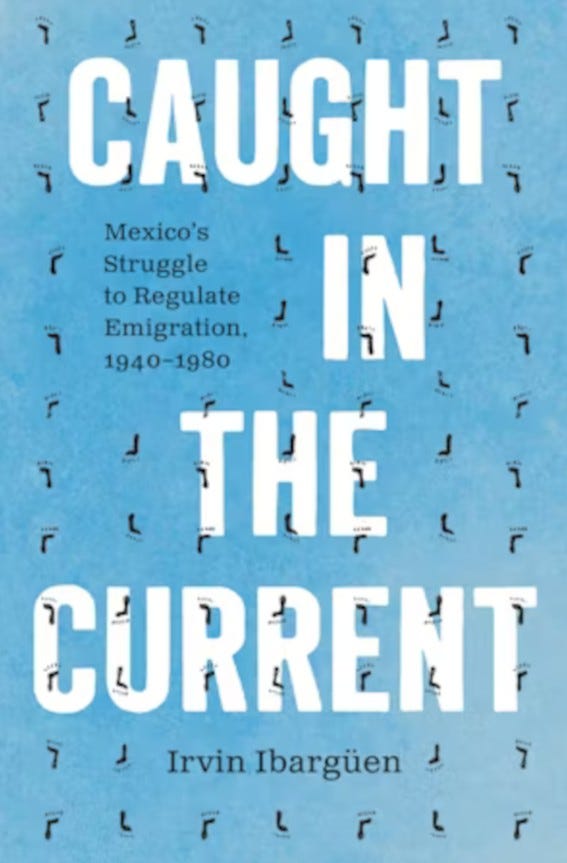
Migration from Mexico to the United States is like the Rio Bravo—a human flow across the border that is vast, powerful and ultimately untameable.
Given that, until now the scholastic reflex has been that politicians in Mexico have stood on the banks to watch this current of labour over generations while making little effort to stem the tide.
In the contemporary climate of extreme hostility to migration, and Mexican migration in particular, it is important to note that this reflex is incorrect, and to recognise that this issue has posed major policy challenges for the country.
Indeed, the Mexican state has always been in two minds about emigration, weighing the benefits against the costs and seeking where possible to foresee and mitigate negative consequences.
Caught in the Current: Mexico’s Struggle to Regulate Emigration, 1940–1980 explores how Mexico navigated the choppy waters of economic migration with a focus on the many political complications created by the Bracero Programme signed with the US in 1942.
Under the terms of this ambitious bilateral guest-worker agreement, Mexico would send tens of thousands of its nationals to work in the US during the harvesting seasons, mainly of fruit and vegetable crops such as carrots, lettuce, and peaches.
Migrants enrolled in the programme would travel and work with formal contracts, supervised by both states, and were to be assured baseline nutrition, housing, and compensation.
It all sounds, well, peachy, but the Bracero initiatve would create multiple complications for Mexico’s then ruling PRI regime, and Irvin Ibarguen’s book shows how it responded, at times by establishing policies to restrain the very migratory current it helped unleash.
Ibarguen has compiled the first systematic study of what he calls “mitigatory migratory policies”—Mexican initiatives to control, mitigate or in some cases even halt the migratory flow—which makes this an important study for considering Mexico’s political agency in this initiative and indeed, at times, hostility to it.
As Ibarguen points out, previous analyses have asserted that Mexico was never torn over whether there should be emigration.
He writes: “Historians are aware of instances in which Mexico espoused a desire to restrict migration. But they regard them as mere chest-thumping and ‘bluster’: the theatrics of a government seeking to improve the treatment of its migrant guest workers by impressing upon US authorities that it could close off the migratory flow if it so wished.”
He analyses government records and deliberations to show that these assumptions are inaccurate and, periodically, as migration created challenges for Mexican politicians, they asked themselves whether continuing with it was indeed worthwhile.
Despite the potential benefits of mass migration, the author argues that it also carried significant risks for Mexico’s government.
Self-evidently, by agreeing to send Mexican workers to the US, Mexico could weaken parts of its economy reliant on cheap labour.
Encouraging people to leave Mexico could also overwhelm the resources of Mexican border towns where large concentrations of migrants were likely to gather before departing as guest workers or, failing that, as undocumented migrants.
Finally, and perhaps more importantly for the instinctively nationalist PRI, an exodus to the US posed significant risks for the party’s reputation is, as expected, a pattern of migrant abuse emerge in the US despite the ostensible protections under the Bracero programme.
While the authoritarian single-party state was an effective steward of Mexican public opinion, it was still sensitive to any threats that such abuses might ascribe some blame to the presidency.
Ultimately, however, Ibarguen shows that while Mexican officials thought they had established a controllable migratory stream, in fact they struggled to arrest this when they wanted to, finding themselves trapped in a powerful current with little room to manoeuvre.
The author writes: “In the end, the migration grew out of their control, overwhelming them and their attempted countermeasures.”
*Please help the Latin American Review of Books: you can subscribe on Substack for just one month ($5) or, if you like what we do, you can make a donation through Stripe