
Forgotten island
Puerto Rico’s colonial status made its debt crisis inevitable. Review: Promise Land: The Inside Story of the Puerto Rico Debt Crisis, David Skeel
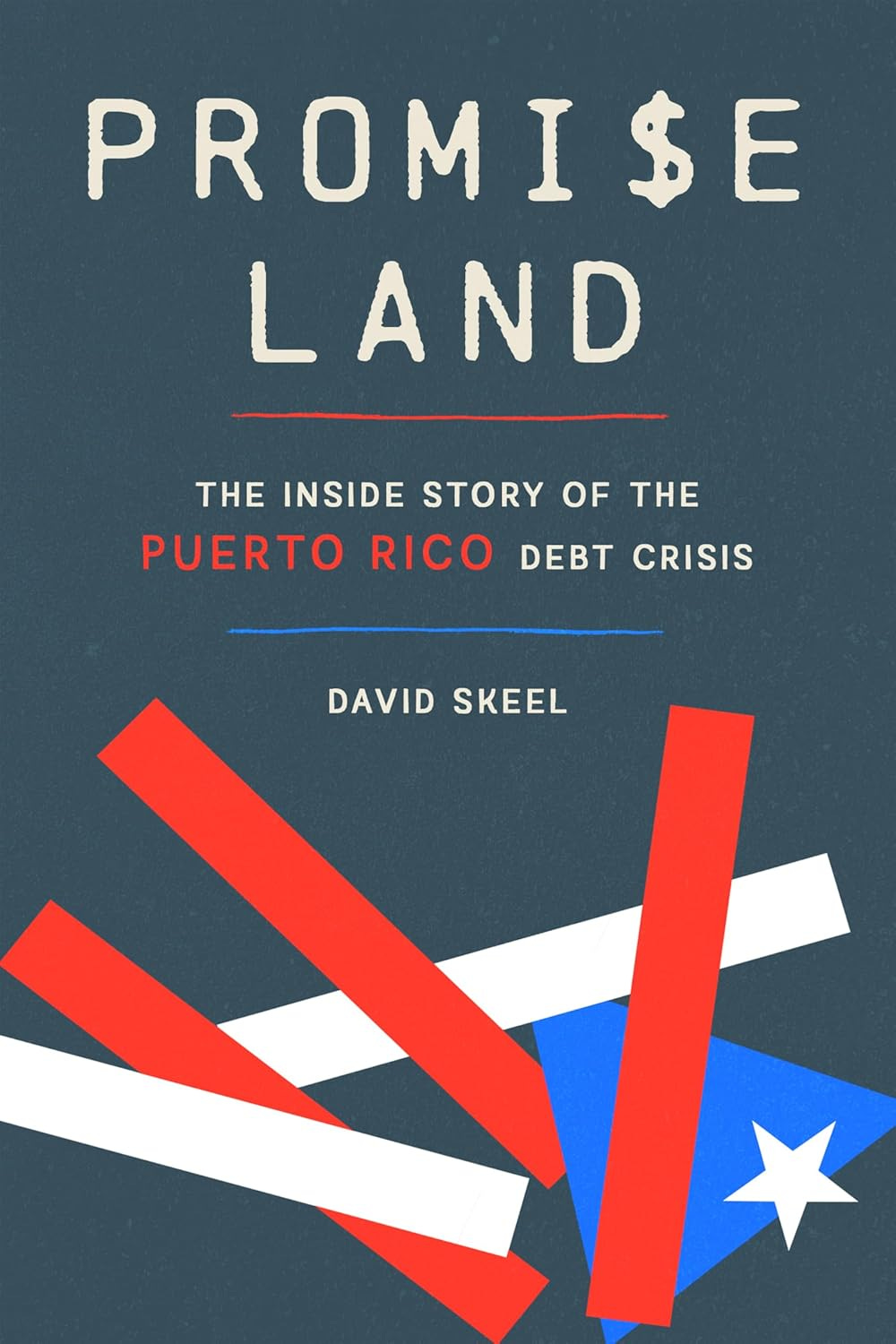
Promise Land: The Inside Story of the Puerto Rico Debt Crisis, David Skeel, 2026, Paul Dry Books
By Gavin O’Toole
Puerto Rico’s monumental debt crisis after 2015 illustrates how imperialism is prepared to sacrifice cherished saws of capitalism in order to maintain its colonial stranglehold.
The scene of the largest governmental default in US history after the island’s governor declared its $73 billion of debt unpayable, Puerto Rico was subjected to an unprecedented exercise in direct colonial control that satisfied no one—least of all private bondholders.
Its plight has been likened to the sovereign debt default faced by Greece following the 2008 financial crisis, except for one big difference: as an unincorporated territory of the US, Puerto Rico was never sovereign and this, of course, had been the main problem in the first place.
Not only has the island long occupied a legal vacuum that denied it the sovereign powers required to manage its economic emergency, its debt trap was itself a product of decades of federal policies that had turned it into a tax haven for greedy Wall Street capitalists.
When the chickens came home to roost, a caste of bondholders in possession of Puerto Rican debt were required under US government restructuring plans to accept significant “haircuts”—reductions on the face value of their investments.
In short, the state—in this case embodied by an unelected junta parachuted in by the US government—was willing to sacrifice certain forms of capital in order to protect others.
It’s a complex story with many actors, not all of whom would lose out, and for the mere mortal it can be hard to unravel the underlying narrative from the financial jargon.
Boiled down to bare bones, the main losers were (some) vulture and hedge funds that had bought Puerto Rican bonds at discounts hoping to profit from its misery—but, more importantly, retail and local investors, not least US mutual funds and residents of the island.
Inevitably, and in keeping with other “sovereign” debt crises elsewhere, that meant the biggest losers would be local retirees and individuals who had invested in municipal bonds.
David Skeel’s account of this travesty is important for one main reason: he was at the heart of the decision-making process, as a key member of the oversight board sent into Puerto Rico to balance the books under the so-called PROMESA law of 2016, and hence playing a central role in the biggest public debt restructuring in American history.
PROMESA is significant as much for what it was not, as for what it was: it was not a “bailout”, a dirty word in Congress yet something that would have been favoured by bondholders, but created a board with power over Puerto Rico’s budget to find a way out of the maze.
In particular, it established a special bankruptcy framework for the island, while avoiding use of the term itself which was riven with connotations that drew attention to its inferior status.
This was a key theme that had contributed to the crisis because, unlike formal US states, the “commonwealth” territory’s municipalities had no access to federal bankruptcy rules and protections.
As Skeel notes, if Puerto Rico were a state, it could have taken advantage of US bankruptcy laws which have a special chapter on municipal bankruptcy for restructuring the debts of a city or government corporation.
Until 1984, the island had been able to do this, but in that year a new definition of “state” was almost inexplicably introduced into legislation asserting that Puerto Rico could be treated just like a state for every purpose under bankruptcy laws except one: authorising municipalities to file for bankruptcy.
To illustrate this anomaly, Puerto Rico’s own attempts at declaring bankruptcy in order to alleviate the aggressive pressure of creditors started in 2015, when its government tried to pass its own bankruptcy laws—and were duly struck down by the US Supreme Court.
Skeel’s book provides an insider’s recollections of the epic struggle to restructure Puerto Rico’s debt and restore fiscal stability in which Washington’s hit squad was not only challenged by protesters furious at the colonial implications of its presence, but by the bondholders it had been sent to rescue.
Indeed, at one stage “Wanted” posters with his picture on them were posted in the campus where he taught denouncing him as a “mercenary” who “demands the blood of Puerto Rican people to pay rich Wall Street bondholders”.
His main role was to contribute his expertise as one of two bankruptcy specialists on the seven-person Puerto Rico oversight board, later becoming its chairman.
The author’s position is ultimately sympathetic and somewhat angry at Puerto Rico’s historic impotence, constantly mindful of the human cost of debt problems on such a scale—the loss by an elderly lady of her life’s savings, small businesses built up over years ruined by incompetent taxation, loyal employees thrown out of work.
This is at once his account of the debt crisis and restructuring on the island, and a nod towards the colonialism that ultimately was responsible for it.
Skeel was genuinely outraged, for example, at the exclusion of Puerto Rican municipalities from US bankruptcy rules, and his tale is one in which this otherwise innocuous term becomes a major political football in a high-stakes match in which he faced considerable opposition.
When we strip away the financial shenanigans that characterise this period—that arguably ended officially in 2022 when Puerto Rico exited its historic bankruptcy after having restructured $74 billion in public debt and $49 billion in unfunded pension liabilities—we are left with the debris of a mess that exposed the island’s nakedly colonial status.
Landmark cases at the US Supreme Court at the height of the debt crisis simply confirmed that Puerto Rico is an imperial possession.
While PROMESA was a viable mechanism for resolving an unprecedented financial collapse, it was an autocratic insult to local democratic governance.
As Skeel indicates, the politics of non-statehood—that is, the purposeful ambiguity surrounding US control of Puerto Rico—meant that neither of its main parties cared much about fiscal responsibility.
And finally, the very crisis itself confirmed the island’s economic dependence and role as a tax haven for unproductive US capital, making the debt trap inevitable.
Moreover, Skeel warns that the Puerto Rican crisis is a harbinger of the future, and the way it was resolved “the last-ditch solution to the kind of crisis that may be brewing in multiple states and major cities elsewhere in America”.
He writes: “The island’s catastrophic decline looks remarkably like developments now unfolding throughout America.”