
Inventing the indigenous
Political turmoil in Bolivia hints at a paradigm shift. Review: Bolivia and the Making of the Global Indigenous Movement, Juanita Roca-Sánchez
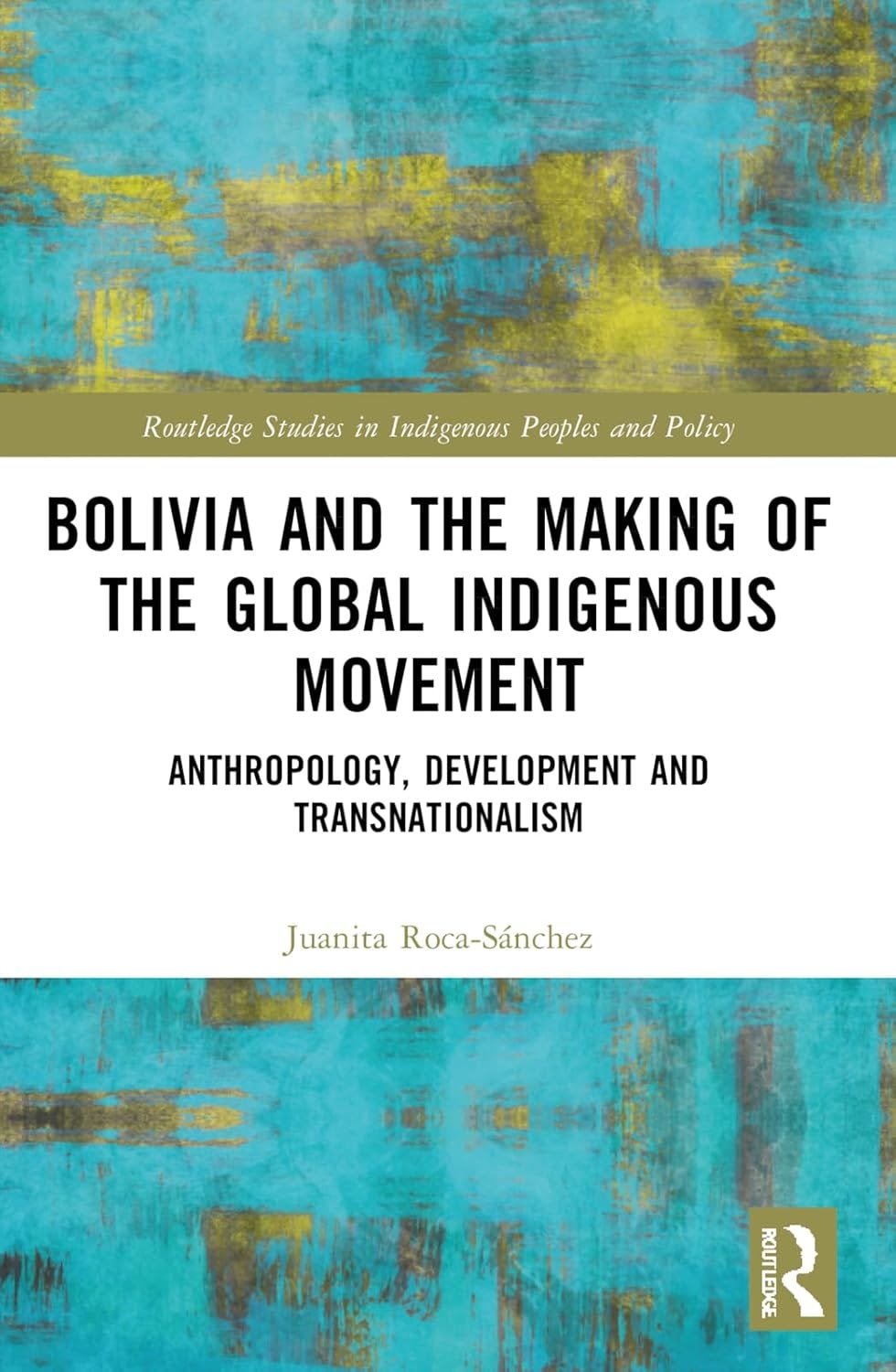
Bolivia and the Making of the Global Indigenous Movement: Anthropology, Development and Transnationalism, Juanita Roca-Sánchez, 2025, Routledge
By Gavin O’Toole
The 2011 TIPNIS dispute in Bolivia may have been the first sign of a paradigm shift in how the term “indigenous” has been constructed and understood globally.
Plans spearheaded by then president Evo Morales for a highway through protected land fractured the coalition that had brought to him power and undermined his carefully crafted image as a champion of Mother Earth and indigenous self-determination.
It exposed deep divisions between indigenous peoples in Bolivia, with local groups opposing the highway confronting those comprising highland indigenous, campesino, cocalero and Movimiento al Socialismo (MAS) syndicalist groups who stood to gain from it.
Moreover, it caused irreparable damage to Morales’ standing in both Bolivia and internationally, arguably representing the beginning of the end of a presidency that critics described as having flouted the constitution and supporters ultimately defended as the victim of a coup.
Perhaps more importantly, however, TIPNIS exposed the fragility of the social category of “indigenous” by then consolidated in global discourse, particularly in its application to Latin America as a discernible legal and constitutional classification worthy of specific rights.
It revealed fault lines within the concept of “indigeneity”, thus providing the first indications of severe strains in the historically recurrent discursive construction of the “indigenous” that had shaped international institutional initiatives since the 1980s.
Juanita Roca-Sánchez explores this discursive history, using Bolivia as an important case study, with a depth and attention to detail that is unprecedented and compelling.
Her work is a reminder to the left—which has a reflex to advance unconditional support for all things indigenous that has its origins among other things in 19th-century allusions to primitive communism (see Kevin B Anderson’s Marx at the Margins)—that it’s never so simple.
Bolivia and the Making of the Global Indigenous Movement explores through historical and ethnographic research how Western anthropological trends, development discourse and transnational activism came both to construct and define the global indigenous movement.
It traces how international ideas of what “indigenous” means have played out at the national level and traces these trends from early 20th-century pre-revolutionary Bolivia through Inter-American indigenismo and multiculturalism up to the Morales era.
In doing so, it argues that the fact that indigeneity can only be understood as a construction over the long term challenges the classic, binary dichotomy between “indigenous” and “whites”, thereby calling for a more nuanced understanding of “plural indigeneities”.
Bolivia is important in this respect for providing a stark example of the influence of the discourse of global indigeneity, vested most prominently in the International Labour Organisation Convention 169 for Indigenous and Tribal Peoples from 1989 and the United Nations Declaration on the Rights of Indigenous People (UNDRIP), adopted in 2007.
In 2009, for example, the country’s constitution was changed to establish Bolivia as a “plurinational” state recognising 36 distinct indigenous nations, and the ancestral notion of “Vivir Bien” was established as a guiding principle for policymaking.
Roca-Sánchez sets out to determine how this happened, underlining how Bolivia became a “laboratory” for social and economic development experiments as a result.
In doing so, she draws attention to controversies that have arisen over the notion of “indigeneity”, which she suggests is arguably not more than 20 years old.
To some academics, indigeneity is increasingly gaining currency and is seen as a resource in identity politics, while to others it remains controversial for setting up an unacceptable opposition with “modernity” by which indigenous peoples are cast as ideal types representing modernity’s “fading pre-modern Other”.
Such typecasting has led to familiar transnational narratives suggesting that all indigenous peoples are natural protectors of nature, have struggled historically for decolonisation, self-determination and difference, and somehow represent preserved pre-colonial traditions—a highly problematic depiction, according to the author.
Roca-Sánchez writes: “Is this, however, an adequate, complete, realistic portrayal of millions of diverse people who might consider themselves or be seen as indigenous, and who might also live in urban areas?
“As some Aymara intellectuals today argue, would these stereotypes not imply some other kind of racism which places people as different to others, due to their cultural differences …?”
The author provides a detailed genealogy of how indigeneity has been constructed historically and identifies three global paradigms of race and ethnicity that have framed inter-racial and inter-cultural relations in Latin America and specifically Bolivia.
The first of these was the evolutionist or social Darwinist paradigm between 1880 and 1948, the heyday of racist political regimes whereby non-European native indigenous societies were considered by anthropologists as backwards and inferior.
The second was the integrationist paradigm that began with the UN Universal Human Rights Declaration in 1948 and ended with the fall of the Berlin Wall in 1989.
This spanned the period of Bolivia’s revolution and responded to a growing global discourse on “development” that was reflected in efforts, at least legally, to abolish racial difference and pursue integration and assimilation policies.
The third paradigm refers to the indigenisation of identities and responded to a global indigeneity ideology that began to crystallise in the late 1960s but was officially inaugurated with the ILO Convention 169.
This current paradigm is shifting, argues Roca-Sánchez, because during the last years of the MAS, which held power until 2025, a national and integrationist agenda with strong centralised government prevailed over policies aiming at indigenous self-determination.
The TIPNIS dispute exposed one of the underlying explanations for this by exposing Bolivia’s undying commitment to a traditional development model of extractivism.
She writes: “Despite the massive propaganda that the MAS government deploys promoting the rights of ‘Mother Earth’ and Vivir Bien, there does not seem to be a willingness to change the model, despite discourses expressing the opposite.”
It has resulted in an “irreconcilable opposition” between the idea of Vivir Bien as a pluralist alternative to modernity and its interpretation within twenty-first century Socialism.
“This leads to a central question: are Vivir Bien and a strong state that concentrates power compatible? Current Bolivian political tensions empirically show that they are not.”
Nonetheless, Roca-Sánchez suggests that while we are seeing the first signs that the indigenisation of identities paradigm is shifting, it is hard to say what will replace it.
She also offers a bleak overview of this paradigm’s achievements in Bolivia, suggesting that the main casualty has been consensus.
Roca-Sánchez writes: “… it seems clear that more than three decades of implementing ILO Convention 169, which marked the indigenous rights legal framework and ideology addressed in this book, has shown to have created more clashes than unity between Bolivian civil society than in other historical periods …
“Indeed, like all global paradigms of race and ethnicity, this one was well intentioned, but its exhaustion is clear. It is time to review it and design something new, while attempting to find its positive outcomes.”
BUY THIS BOOK: UK/Europe
A very interesting aspect is brought up in this book. The global indigenous ideology has, in fact, taken an even more peculiar form in India, especially under post 2014 right wing hindutva state, wherein all the 'tribal' and adivasi communities are put forth as a homogenous collective who are against the Western, secular, 'Eurocentric' model of development, but at the same time are being coerced to give out their ancestral lands to big corporate mining companies. But a perspective from Latin America, where the pink tide has sort of consolidated itself around indigeneity, is definitely one to be taken seriously.