
Invisible encounter
A study of racial politics mounts a challenge to area studies. Books in brief: Transpacific Nonencounters: Racial Disconnects Across Twentieth-Century Japan and Mexico
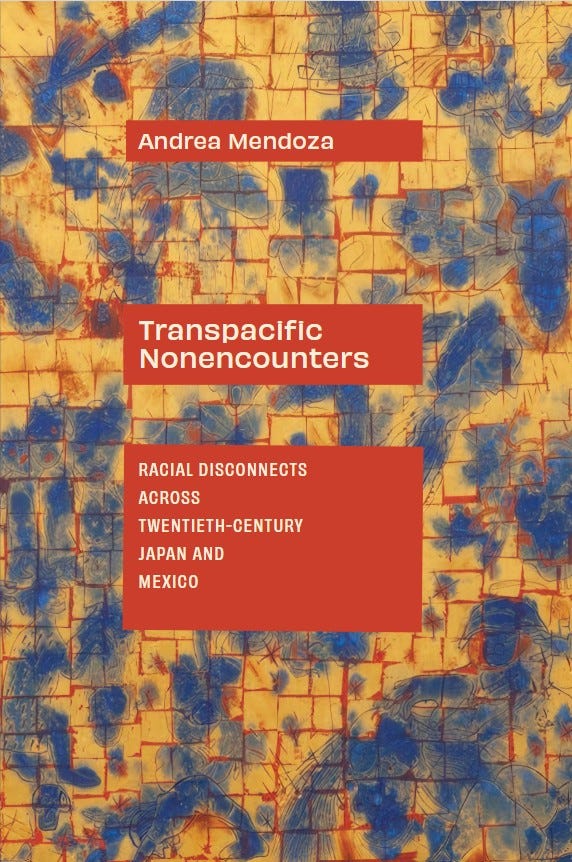
Transpacific Nonencounters: Racial Disconnects Across Twentieth-Century Japan and Mexico, Andrea Mendoza, 2026, Duke University Press
By Gavin O’Toole
If theoretically complex at first sight, Andrea Mendoza’s speculative consideration of racialised and gendered colonial settler oppression in Japan and Mexico can be reduced to an argument that is both digestible and original.
Its point of departure is that the apparent lack of meaningful empirical connections between historical cases she identifies in both countries is an asset when considered part of a challenge to the neat, regionalised epistemic boxes created by area studies.
Those cases begin with a reference to systematised racial violence against girls of Korean descent in Japan and the heterosexist underpinnings of religious colonialism in discourses that justify the oppression of Zapotec women and girls in Mexico.
Mendoza argues that the imperialist framework that heralded the establishment of area studies in US academia during the Cold War was based on dividing the humanities and social sciences into epistemological boxes.
In turn, “the echo chambers of disciplinary authority teach us that disconnection premises the particularity of an ‘area’ or ‘field’.” In other words, disconnection has been epistemically constructed.
Even before the Cold War, the anthropological method offered epistemologies that sustained the “incommensurability of human subjects” based on an array of racial colonial categorisations that reified cultural difference.
Post–Cold War critiques, however, including postcolonial thought and theories of decolonisation, have challenged this to explain the workings of subjugated knowledge and its role in silencing colonised peoples.
Transpacific Nonencounters: Racial Disconnects Across Twentieth-Century Japan and Mexico argues that key texts of Japanese and Mexican intellectual and cultural production generate a critical perspective on transpacific racial politics that extends conceptualisations of global racism.
The author examines the formation of philosophies of race and racism across Mexican and Japanese intellectual histories and cultural productions of the twentieth century to rethink the ongoing effects of transpacific imperialism and nationalism.
Her point of departure is the construction of racial ideologies—Pan-Asianism, which promoted the construction of a multiracial and multiethnic Japanese imperial identity; and mestizaje, which promoted the supremacy of Mexican racial polygenism by promoting the “whitening” of the Americas through miscegenation and Indigenous dispossession.
Mendoza argues that while these ideologies did not shape or influence each other in any proven way—they were not empirically connected—they can be considered together in terms of an intensifying racist world order and hence shaped modern transpacific racial politics.
She writes: “The ideological formations and residues of Pan-Asianism and mestizaje reveal a common strand of thinking among elite male intellectual and political actors that fomented figurations of modern state power and their long-standing cultural impact.”
This is important in itself, but the author also argues that finding meaning in resonance without direct relatability has been a key practice for the anticolonial feminist politics of solidarity.
The conceptual depth of this book is at times quite difficult, but there is no doubt that Mendoza is on to something when prioritisng the idea of “nonencounters” in the broader context of colonialism which, she argues, provides a way of reading against spatial registers of nation- and area-based models of study.
She writes: “Attending to a perceived absence of encounter or connection requires us to dismantle not only how we traditionally privilege evidence as a basis for empirical comparisons but also the ways that Asia and Latin America are broadly imagined as disparate fields for study and therefore as almost hermetically sealed off from one another.
“Indeed, the very conception of ‘Latin America’ and ‘Asia’ as geopolitical ideas as early as the fifteenth century was premised on the paradox of their equivalence and disparity within the cartographies of colonialism.”
BUY THIS BOOK: UK/Europe