
Khaki democrats
Hard as it is to swallow, militaries have at times been the midwives of democracy. Books in brief: The Birth of Democracy in South America, Raúl L Madrid, by Gavin O'Toole
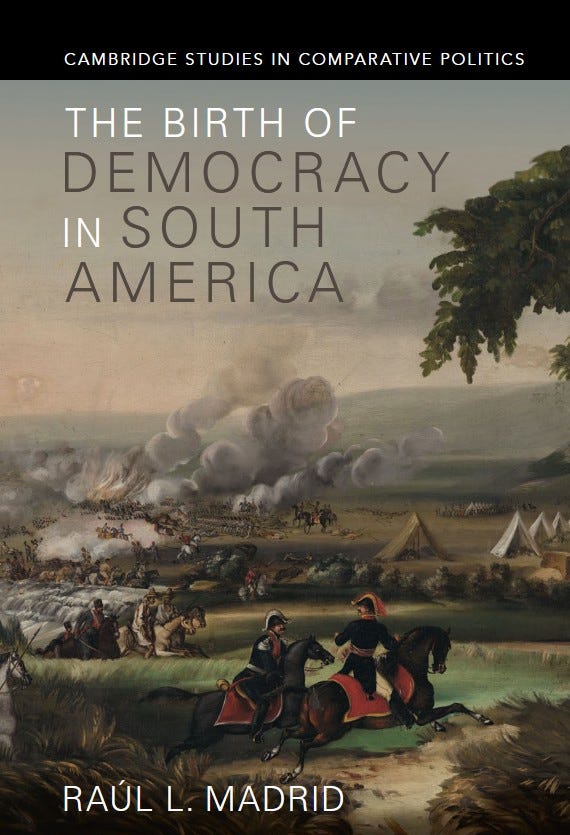
The Birth of Democracy in South America, Raúl L Madrid, 2025, Cambridge University Press
Writing against the backdrop of endless US efforts to distort Latin American democratic politics—often reflected in historical support for militaries in the region—it is hard to escape the conclusion that the Anglo-American world is ambivalent about democracy.
Yet at the same time, and perversely, the dominant narrative that has continued to drive US foreign policy—at least until the arrival of Donald Trump—has assumed democracy as its own in a form of white civilising mission underlying the Monroe Doctrine.
This perspective has shaped the entire historiography of Latin America to such an extent that it has influenced how the region sees itself. The very norms of democratisation—transition, consolidation, erosion—are all taken as read from the Anglo-American liturgy.
The truth, however, is that in South America many governments were holding elections regularly and in some cases allowed near universal suffrage at a time when the US and most European countries imposed significant limits on which citizens could vote.
Indeed, as Raúl Madrid notes in The Birth of Democracy in South America, this region was something of a democratic pioneer, enacting constitutions after Independence that established representative institutions and significant civil and political rights.
Yet not only has intellectual colonialism sidelined this reality, it has also hampered the efforts of political scientists to answer the most important question within the discipline about the origin of democracy.
As Madrid points out, political historians still lack a persuasive theory about what led democracy to emerge in South America.
His book takes a signifcant step forward in formulating an answer, in so doing highlighting what is puzzling about the rise of democratic regimes in South America from the perspective of traditional class or modernisation theories.
Madrid suggests that in countries such as Colombia, Argentina, Chile and Uruguay democratisation can be attributed to neither the working classes or bourgeoisie, nor to modernisation, and instead involved two main actors—the military and political parties.
Military professionalisation began to make democracy feasible by handing the state a monopoly on violence, curtailing the opposition revolts that plagued the region, and thereby compelling opposition forces to adopt a constitutional, electoral path to power.
The military has traditionally been viewed as an obstacle to democracy in Latin America, Madrid notes, “Thus, one might expect that the strength of the military would be inversely related to the likelihood of democratisation.”
Yet the evidence suggests that in some countries, strong militaries enhanced the prospects of democracy, reducing the incentive of opposition groups to pursue an armed route to power.
Madrid’s original approach is highly significant because it represents the first comprehensive analysis of the origins of democracy in South America, while courageously attributing an historical role in its emergence to an actor hitherto seen as antithetical to democracy.
As the author shows, it was not so much the presence of the military as its relative strength that was the major factor, with strong militaries in some cases more likely to be conducive to democratic outcomes than weak ones.
Fast forward to the recent era, for example, and the author notes the inverse relationship between the strength and level of professionalisation of the armed forces and the degree of repression in Latin America, especially during the guerrilla revolts of the late 20th century.
He writes: “The greatest repression, especially on a per capita basis, occurred in those countries where the guerrillas were the strongest, especially Cuba and the Central American countries, which were generally countries with relatively weak militaries.”
*Please help the Latin American Review of Books: you can subscribe on Substack for just one month ($5) or, if you like what we do, you can make a donation through Stripe or PayPal (send your PayPal contributions to editor@latamrob.com