
Liberal limits
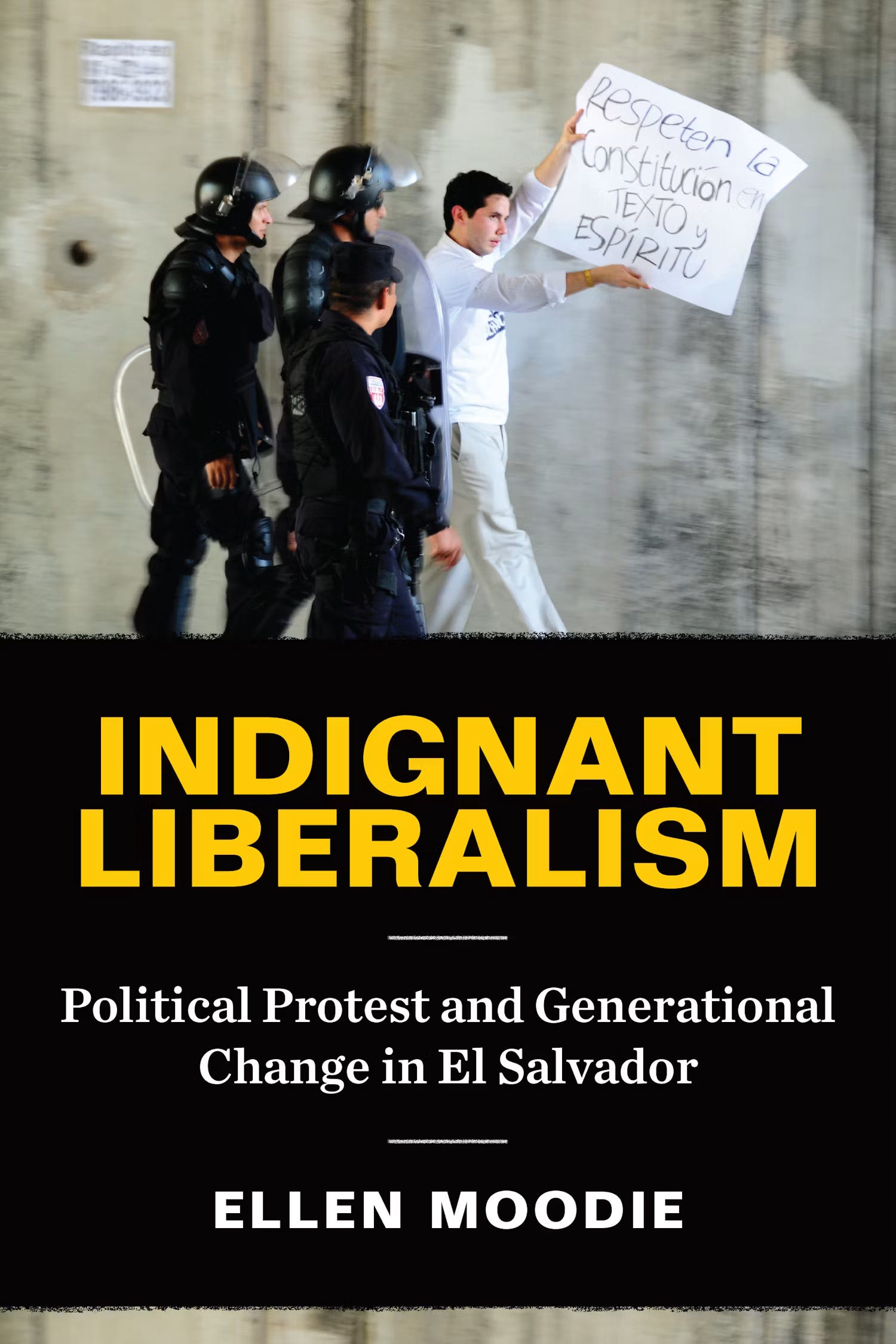
El Salvador reveals the failure of a dominant idea. Review: Indignant Liberalism: Political Protest and Generational Change in El Salvador, Ellen Moodie
Indignant Liberalism: Political Protest and Generational Change in El Salvador, Ellen Moodie, 2026, University of Texas Press
By Gavin O’Toole
If the Left’s inability to transform El Salvador through either revolution or democratic politics has been dramatically underlined by Nayib Bukele’s populist stranglehold, this has concealed an even greater failure.
The historical project of liberalism has collapsed in a country where it has played a dominant role in shaping governance and the institutions of representative politics, particularly since the 1992 peace accords.
The implications extend beyond this small Central American state, alluding to both the insurmountable difficulty of superseding the class polarisation of the civil war era and to the ingrained challenges of institutionalising democracy.
Ellen Moodie became sensitive to this failure and the profound contradictions within liberalism when she turned her attention to a small—and what many might regard as historically insignificant—Salvadoran movement from 2011.
This was a year of global activism—the Arab Spring pro-democracy uprisings, the Indignados demonstrations in Spain, mass mobilisation in Greece, Iran, Turkey and Bulgaria, and the beginning of the Occupy Wall Street movement in New York City.
In that year El Salvador witnessed its own protests by the Indignados-SV, so-called in a nod to their Spanish counterparts—a movement of young, middle-class urban residents with a decidedly tame agenda: to protect the integrity of the Supreme Court.
Their demand was to repeal Decree 743, a measure passed by El Salvador’s legislative assembly that required all rulings on constitutionality to be unanimous, rendering the country’s judicial authority all but powerless.
Their chants in the streets and on social media came under the banner of one, admittedly unsexy slogan: “Institutionality!”
As Moodie points out, unlike the guerrillas of the 1980–1992 civil war, the protesters did not want to overthrow the state but merely wanted what their constitution prescribed: a fair, impartial state, and they succeeded, with the decree thrown out after two months of protests.
Within 10 years, however, Bukele had fired all the justices from that same court and had packed it with loyalists as he imported the “authoritarian playbook” developed elsewhere. Those new judges would then sanction his unconstitutional second run for president that resulted in his 2024 re-election after a landslide vote.
Moodie seeks to locate this dramatic shift in the country’s political fortunes within the contradictions of liberalism, an ideology that in the longue durée has shaped El Salvador’s political settlement, especially in the postwar period.
Versions of liberalism have underpinned its 13 constitutions, shaped the peace agreements of 1992 and brought the Indignados to the streets, and despite the Bukele interregnum the author’s underlying motive is to consider their enduring appeal.
Her argument is that the rise of illiberalism in El Salvador—embodied by Bukele—can be understood by examining the limits of liberal promises and practices in a historical context, in particular “ever promising liberty and never coming through for the majorities”.
Moodie writes: “One key to understanding Bukele’s rise comes from a re-examination of liberalism’s imagined futures. Most Salvadorans were never included in the liberalism on which the country was founded … History shows us that liberal modes of institutional power have always led to unequal outcomes. Thus, Bukele’s rise must be a symptom, not the cause, of the failures of liberalism.”
To understand how we got from the political opening in the early 2010s to the election of “the world’s coolest dictator” we must go beyond tropes of El Salvador’s authoritarian inheritances or the premise of “democratic backsliding” preferred by political scientists to explore the contradictions of liberalism.
Moodie examines its evolution as an idea in El Salvador historically, from the early days of the Conquest through independence in the 1820s to protests in the mid-twentieth century.
As in much of Latin America, liberalism drove the criollos who led the independence movement, inspired by the European Enlightenment and French and American revolutions.
Liberal federalist sentiment established its stronghold in the United Provinces of Central America (1823–41), formed by El Salvador and its neighbours after the country had been briefly absorbed into the Mexican Empire.
Economic liberalism benefiting elites drove the country’s transition in the late 19th century into a coffee-exporting economy, marginalising the majority of the population and setting the scene for the later rural conflicts that would underpin the civil war.
Moodie considers the rise of the middle-classes and their relationship with democratisation under modernisation theory, which as she notes is central to the liberal progress story, and how liberalism informed a new postwar generation.
She explores the rise of the Indignados, how generational ideological differences shaped responses to them, and contradictions in liberal approaches to gang violence, a key issue in politics.
This is, therefore, in part a story about generational change in politics, for the Indignados-SV comprised a new Salvadoran constituency with no direct experience of the traumas of the 1980–1992 war.
Bukele himself is a representative of this generation, “a millennial adman with inherited wealth who turned into an iconoclast politician” who practised a new form of politics that relies on broad public discontent with democracy and easy access to social media.
This study is also an indictment of what the author identifies as “racial liberalism”, an ideology that evolved in tandem with European racism and nationalism that seeks above all to uphold the status quo and ultimately postpone equality.
The author suggests that although Farabundo Martí National Liberation Front’s 2009 electoral victory after two decades of conservative rule had pointed to new political possibilities for younger Salvadorans, this essentially Marxist party was unable to escape the logic of liberal structures, of which it had by then become a part.
Many former supporters and wartime comrades felt abandoned, creating space two years into the tenure of President Mauricio Funes for frustrated Salvadoran Indignados and other protesters that Bukele’s authoritarian populism would exploit.
Moodie writes: “The onetime revolutionary force of the FMLN had in 1994 converted to a political party within the constraints of the liberal state. Reformatting leftist demands in a liberal terrain can be, was, treacherous. The FMLN could never fulfil many of its political promises—especially those remembered, if no longer enunciated, as socialist aspirations.”
In short, she notes, instead of resisting extant racist and patriarchal structures and of working towards the freedom and equality that liberalism promises, the FMLN had reproduced the coloniality of power.
It is this that explains why some political scientists consider manifestations of populism to be an illiberal response to undemocratic liberalism, an effort to correct a “rigged” system.
At the same time, populism weakens the institutions of liberal democracy through attacks on institutionality in its many forms (courts, press, the balance of powers) and by eroding support for democratic values.
This latter characteristic is amply illustrated by Bukele, whose stewardship has nurtured in swathes of the population an indifference to constitutionality.
Yet as Moodie repeatedly shows in this book, the promise of liberalism continues to sustain progressive political hopes in El Salvador and criticism of Bukele, even from within former FMLN cadres.
She concludes by citing a former FMLN leader, who repositions the 10 years in which the revolutionary party held power prior to Bukele within a far larger history that began with the liberal independence heroes that broke from Spain in the 1820s.
It makes huge sense to locate populist authoritarianism in the failure of liberalism for the majority of people in societies where such ideas are foundational and, as such, Moodie provides important insights into how illiberalism—and hence authoritarian populism—can arise.
And despite Bukele’s grip on power, her story is ultimately hopeful, suggesting that liberalism as an aspiration in El Salvador is not fatally compromised and that liberal ideals are still worth pursuing.
BUY THIS BOOK: UK/Europe
Very interesting text and comments. Now, where is the FMLN in all of these transformations? I'm asking, not where is liberalism, but where is the left?
It's been incredibly sad to see how much more effective his rule has been than any of his predecessors at restoring a semblance of peace in the country. I truly struggle to see how liberalism could return to El Salvador after the impressive results of Bukele's rule. It is truly staggering to see the former most dangerous country on earth now display the lowest murder rate in the Western hemisphere, all of which was almost single-handedly achieved by Bukele's authoritarian rule. It has been truly disheartening and his example will have serious consequences throughout Latin America, starting with Abelardo. Liberalism has been in retreat for a long time, and the relative incompetence of all of Bukele's predecessors makes it very hard for us to dispel accusations of being out of touch or downright irrational. I suspect we will see his copycats fail to achieve anything close to his track record, but it will be a very long time until liberalism has its credibility restored.