
Licensed to kill
A history of police violence against Mexican Americans is timely in the era of Trump. Review: Brown and Blue, Brian D Behnken, by Gavin O'Toole
Brown and Blue: Mexican Americans, Law Enforcement, and Civil Rights in the Southwest, 1935–2025, Brian D Behnken, 2025, University of North Carolina Press
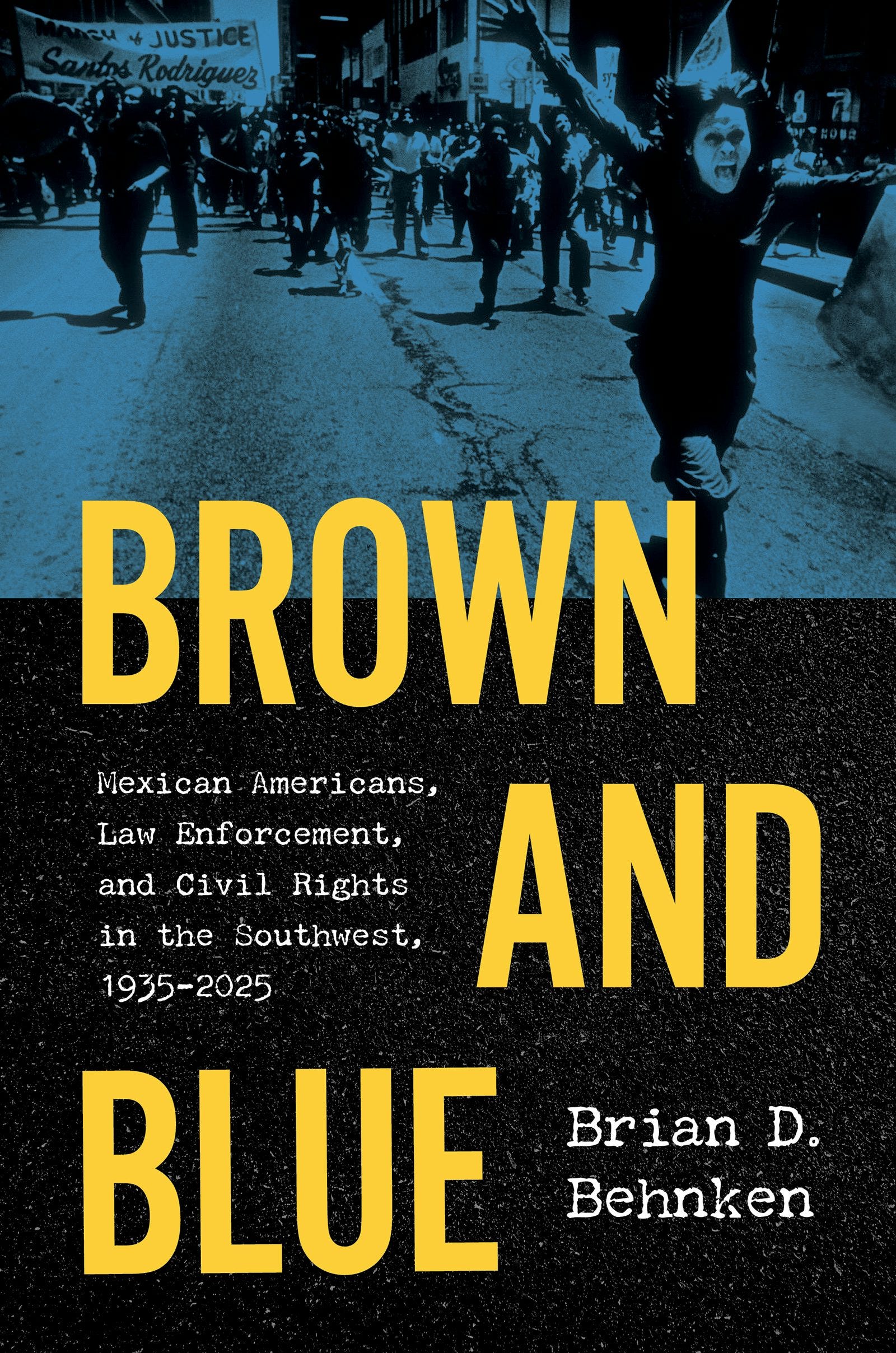
Santos Rodriguez was just 12 years old—and handcuffed—when Dallas police officer Darrell Cain played Russian roulette with a firearm against the back of his head on July 24, 1973.
It was an excessively savage attempt to force a confession from the child and his brother as they were trapped in a police car accused of a burglary they had not committed—and it went catastrophically wrong.
On the second pull of the trigger, Cain’s gun fired, killing the boy instantly and traumatising for life his 13-year-old sibling David who witnessed the execution and was then left locked in the vehicle with his brother’s corpse for a further 10 minutes.
This clear-cut and senseless case of police murder would spark large and violent protests among Mexican Americans in Dallas in one of the city’s few racial uprisings.
It was also the cue for this book by Brian Behnken examining endemic police violence in the US towards Mexican Americans, which forms the second title compiled from a decade of research into a phenomenon that stretches back to the 1830s.
Behnken purposefully begins his study by looking at the police murder of unarmed children like Santos, egregious cases of inexplicable brutality, but the book is not confined to victims who are minors.
Brown and Blue: Mexican Americans, Law Enforcement, and Civil Rights in the Southwest, 1935–2025 is a history of violence towards this ethnic group and the resistance it fuelled in the form of a growing Mexican American civil rights movement.
It is a timely volume for two main reasons: once again, Mexican Americans find themselves at the sharp of end of increasingly vicious law enforcement and immigration agencies that the recent case of Renee Good demonstrates are ready to use fatal force at the drop of a hat.
And secondly, as other titles argue, it challenges the far-right narratives propagated by Donald Trump that invert the direction of causality by suggesting this key demographic—there are 37.5 million Mexican-origin people in the US (60 per cent of all Latinos), the nation’s second largest ethnoracial group—is a major driver of violence in US society.
Brown and Blue explores the relationship between law enforcement and the criminal justice system and the Mexican-origin community in the US Southwest—Arizona, New Mexico, southern California, Texas, and occasionally Colorado (the states where Mexicans and Mexican Americans predominate)—a policing history that is, surprisingly, not well known.
And the first observation it makes is that Mexican Americans have suffered a lot of violence at the hands of law enforcement agencies: the book is littered with harrowing descriptions of police abuse, harassment, and murder.
Alongside violence and discrimination within the criminal justice system, Mexican Americans have also been frequent targets of that unique American species of white paramilitary—the vigilante.
The author’s historical research has shown how various forms of “extralegal justice” common in the 19th-century continued well into the 20th and have done so to this day.
In exploring these cases, Behnken offers an insight into how racist Trumpian narratives might arise, noting how the criminal justice system worked hard to insulate itself from criticism and change following police violence and to discredit victims as deserving low-lifes.
A number of legal conventions have been consolidated as a result, concepts such as “qualified immunity” which grants officers protection from civil lawsuits after a case of police violence, or the “objectively reasonable standard”, which asks whether an ordinary person would act as the officer did (usually expressed in such phrases as “I feared for my life”).
These have reinforced pre-existing conventions long used to justify police or extralegal violence—from the “ley fuga” or law of flight, which gave officers the power to kill suspects as they fled by shooting them in the back, no matter their age, to vagrancy and loitering laws.
As the author points out, despite the well-known excesses of armed US police towards minorities, the case of Mexicans in the Southwest is nonetheless unique.
That is because this part of the US needed Mexican Americans—as workers, voters, civic actors, and cultural creators who also at times have held some power within the criminal justice system itself as police officers, attorneys or judges.
This has meant that the criminal justice system could not abuse Mexican Americans indiscriminately without risking a reaction, and resistance has been a recurrent characteristic of the Mexican response to police violence.
The author discusses how the nature of resistance changed in different periods in the context of the broader civil rights experience of the Mexican American community.
During the 1940s, 1950s and early 1960s, as Mexican Americans pushed for integrated schools, voting rights, desegregation, and equality in the delivery of public services, there were also struggles for more inclusive policing and challenges to racism in the justice system.
In this period cities, counties, states and even the federal government classified Mexican-origin people as white—a strategy that delivered few benefits and that was challenged by the Chicano movement, which understood this to be out of step with their lived reality.
The Plan de Aztlán, which sketched out Chicano organisational strategy, implied that Chicanos were proudly brown, not white—a shift that gave them considerable political, social, cultural, and psychological power in interactions with the police.
Mexican resistance to police abuse is a story that offers some hope for other minorities, and reforms won through civil rights activism transformed the criminal justice system.
Behnken points to the landmark case Hernandez v Texas (1954) which not only barred the exclusion of Mexican Americans from jury service but extended the Equal Protection Clause of the Fourteenth Amendment of the Constitution to all Americans.
The Escobedo v Illinois (1964) and Miranda v Arizona (1966) cases enumerated the treatment of those in police custody or undergoing interrogations, with the now ubiquitous “Miranda rights” an important feature of police interactions with suspects.
Reforms have also led to the diversification of police forces through minority recruitment, increasing the numbers of Mexican American officers.
But, as the author notes, reforms can be reversed—and the political climate has changed considerably since the 1980s.
His final chapter explores the period between the 1990s and today, with Bill Clinton’s 1994 Crime Bill and the War on Drugs spawning massive new police forces and militarisation that have led to a new era of abuses.
Behnken traces to this period an “explosion” in the number of police officers in the US, law enforcement budgets, and powers handed to officers—all of which have fuelled some of the worst cases of police abuse and murder over the past thirty years.
He concludes: “The activists of the sixties and seventies, like those of today, and many of their allies—as well as some of their adversaries—wanted to see things change. They sought then a brave new world, and I would argue that for a short time, in a few locales, some of them got to live in it. But as with most brave new worlds, it was fleeting. Not only did things revert to the ways they had been before, but in some ways things got worse.”
We might speculate from Behnken’s excellent historical analysis, and in particular his conclusion, that at the level of theory there are good reasons for the reversal of past reforms.
The systemic nature of violence by state agents never happens in a vacuum—indeed, it cannot—and is always a reflection of underlying social relations.
Brown and Blue (and Behnken’s first volume, Borders of Violence and Justice, 2022) highlights a long history of the institutionalisation of racism, whose persistence reveals how the entire apparatus of state repression in the US that includes the National Guard, military, Border Patrol, ICE, FBI, NSA and the judicial and carceral systems continues to treat Mexican-origin people as a colonised group.
Like other minorities, Mexican Americans face insurmountable social obstacles to escape their condition as workers while the police, as guardians of wealth and private property, are a key pillar of the capitalist state that needs to keep them in their place.
Engels argued that the police are merely “special bodies of armed men” enjoying a monopoly on lawful violence separated from the working class and loyal only to the ruling class whose interests they defend.
In this respect, racist police violence against Mexican Americans is simply a reflection of the racist violence of a capitalist system that inflicts poverty on an entire working class—but, more alarmingly, will continue to do so until the state’s machinery is dismantled.
*Please help the Latin American Review of Books: you can subscribe on Substack for just one month ($5) or, if you like what we do, you can make a donation through Stripe or PayPal (send your PayPal contributions to editor@latamrob.com
I didn't know about Santos Rodriguez. Thanks for sharing information about this boy and this book. Works like these prevent people voices that were abused from being silenced again.
Powerful review, the vagrancy and loitering laws connection to police violence is something that doesn't get enough attention in histories of racialized policing. The way Behnken traces how legal frameworks like "qualified immunity" and "objectively reasonable standard" built on older discriminatory practices shows the continuity between past and present. What struck me was the argument that reforms can be reveresed when social relations haven't fundamentally changed, kinda reminds me of how civil rights gains in other areas get rolled back when political winds shift. The systemic analysis at the end about Mexican Americans as a colonized labor force ties it all togehter nicely.