
Mexico’s foreign fetish
Studying abroad has been an elite status symbol that has damaged sovereignty. Review: The Future in Their Hands: Making Mexico’s Foreign-Educated Elite, Rachel Grace Newman
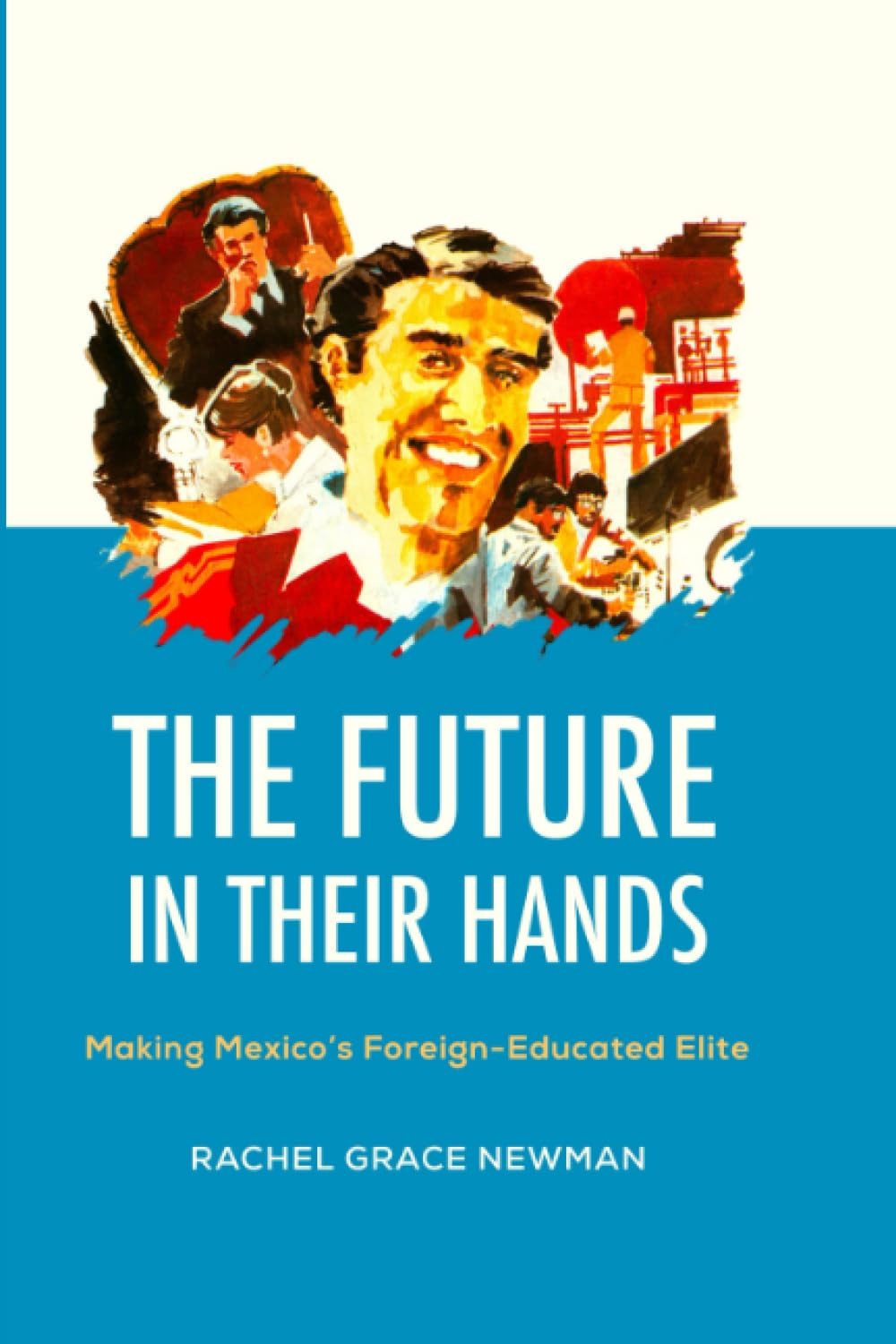
The Future in Their Hands: Making Mexico’s Foreign-Educated Elite, Rachel Grace Newman, 2026, University of California Press
By Gavin O’Toole
How ironic it is that Carlos Salinas de Gortari, a former Mexican president whose historical role is synonymous with the disastrous consequences of worshipping US ideas, is the nephew of Eli de Gortari.
From 1988–94, Salinas de Gortari trumpeted the country’s transition into the “first world” with wholesale neoliberal economic reforms built on the unshakeable substrate of the so-called “Washington Consensus”.
The signature achievement for which he will be remembered was to take Mexico against the odds into the North American Free Trade Agreement (NAFTA) with the US and Canada, thereby earning him a unique status as a modernising visionary.
Salinas did so, however, on the basis of a political trajectory built entirely on inflation—in this case, the inflation of his credentials as an economist who had burnished his intellect to the point that it veritably gleamed from postgraduate study not in Mexico, but in the US.
He had earned a master’s degree in public administration from Harvard University in 1973 then went on to complete his PhD at the Harvard Kennedy School in 1978.
He was, quite simply, one of those elite Mexicans who studied at elite foreign universities—and as he pursued an agenda favoured by his international acolytes of mass privatisation and financial globalisation, the country and his fans abroad never tired of hearing it.
Look back at any of the gushing reports about his genius vomited out by the Financial Times or Wall Street Journal in this period, and the prefix to references about him repeated ad nauseam was always: “Mexico’s Harvard-educated president”.
Such was the illusion of infallibility conjured up by this magical moniker that Salinas was feted and lionised wherever he went, especially in the US.
What a surprise it was to his deluded countrymen that his sexenio not only ended in ignominy, but that Mexico would be struggling with the ripple effects—a low-intensity guerrilla war, the arrest of his brother for assassination, and the collapse of the peso and thence of the economy—for years thereafter.
In short, Mexico paid a very high price indeed for putting this man on a pedestal largely on the basis that he had attended a few modules at a college for rich kids in the imperial north.
As a notable critic of studying in the US, Eli de Gortari, his uncle, might have foreseen all of this. Writing in 1963, the philosopher of science suggested that norteamericanos wanted to steal as much highly educated talent as they could and that the scholarships they offered young Mexicans to attend American universities had a nefarious purpose.
He was voicing a concern that Rachel Grace Newman notes in The Future in Their Hands: Making Mexico’s Foreign-Educated Elite had been expressed since the 1920s by nationalists about the threats to sovereignty that might result from sending youth to study in the US.
There is little doubt that the repercussions of the Salinas era have been debilitating for Mexican sovereignty: NAFTA codified free-market capitalism for all time, making it all but impossible for subsequent administrations to change economic policy direction.
So-called “free trade” has locked Mexico into extreme dependence—more than 80% of its exports go to the US—which has handed Washington immense political leverage over its weaker neighbour. Take for example Trump’s recent threats of crippling tariffs to pressure Mexico into altering its immigration and border policies.
And, notwithstanding the Chiapas rebellion at the end of Salinas’s tenure which in significant part was a direct response to the existential threat posed to Mexican ejidatarios by US corn flooding the market, the country has lost any semblance of self-sufficiency in dietary staples.
Indeed, once famed for its sheer abundance, Mexico has become structurally dependent on the US for its basic food supply—catastrophic, self-inflicted sabotage of traditional food sovereignty by its metropolitan elite.
In that respect, then, Newman’s observations are pertinent, but as she also notes it would be unfair to tar all Mexicans who study abroad—the vast majority of whom have been from middle- or upper-class families at ease with international norms—with a technocratic brush.
She writes: “Even today, the biographical fact of a foreign education can become grounds for easy political typecasting as a neoliberal sellout. The best-known foreign-educated Mexicans of the past century were the three Ivy League presidents of the 1980s and 1990s: Miguel de la Madrid, Carlos Salinas de Gortari, and Ernesto Zedillo, who led the Partido Revolucionario Institucional (PRI) away from economic nationalism. But these three men do not represent all foreign-educated Mexicans.”
Citing the political historian Roderic Camp, who has exhaustively documented the formation of Mexico’s elite, she cautions us to be wary of using foreign student experience to explain technocratic politics.
She points out that foreign-educated Mexicans have been ideologically heterogeneous—there were nationalists and neoliberals, conservatives and leftwingers.
The Future in Their Hands: Making Mexico’s Foreign-Educated Elite is an excellent contribution to the debate about the real value of foreign study to Latin American countries in a world of highly unequal power at both international and domestic levels.
Newman observes both how the metropolitan centre—the US, and also countries such as the UK—have used their educational prowess and scholarships to enhance their dominance.
She writes: “Since the turn of the twentieth century, private and government actors based in the United States and the United Kingdom pursued geopolitical dominance by sponsoring the elites of other nations and colonies to study in their universities. This was ‘cultural diplomacy’ that would enhance the ‘prestige’ of US and British centres of knowledge.”
Today, this process is described under the rubric of “soft power”, a theme that in the UK at least is now explicitly debated in terms of its contribution to national security and not the development of friendly academic relations or the internationalisation of knowledge.
The author has traced the historical evolution of scholarship programmes and the underlying motives of both the recipients and the Mexican state from the period of the Porfiriato to the recent era.
She argues that these phenomena—beneficiaries and state formation—are interlinked, because on the one hand these beneficiaries acted in their own elite interests, and on the other, as a result, they invariably would influence state policy “as insistent citizens, pushing for access to a specialised benefit” and the state’s vision of Mexico’s role in the world.
Newman writes: “Rooted in Mexico’s unequal society, the politics of study abroad are also inextricable from debates on how one builds a modern Mexican state and nation in an unequal world where knowledge and power are centred elsewhere … The politics of study abroad are the elite politics of self-preservation and self-justification, even as they also impinge on questions of sovereignty and nation.”
Put this way, foreign study has always been a marker of class and status in a country that has, slowly but surely, built its own domestic public education system of world-class universities and research, and that enjoys a profusion of intellectual talent.
But as early as 1983—just months after the young Salinas was appointed to his first major role in government as the Secretaría de Programación y Presupuesto by President Miguel de la Madrid—the esteemed academic Enrique Beltrán was stating that Mexicans no longer needed to study abroad.
Although he was foreign-educated himself, Beltrán told an interviewer candidly that he no longer saw any intrinsic value in studying outside of the country, and would not recommend that young people study in Europe or the US.
“We are already getting past this phase that all countries have gone through: going to seek knowledge in other places,” he said, insisting that Mexico’s own experts were perfectly capable of training their successors.
It was wise advice that the bourgeois elite enamoured of all things foreign ignored, as the story of Salinas demonstrates—with calamitous repercussions for sovereignty.
BUY THIS BOOK: UK/Europe
The primary returns for foreign‑trained acolytes are alignment with metropolitan capital and elite accumulation through a Swiss bank account, not knowledge aimed at national self‑sufficiency or public welfare.