
Migrants or animals?
Racialised border control has its origins in US efforts to prevent animal diseases. Books in brief: Deadly Divide, Mary Mendoza
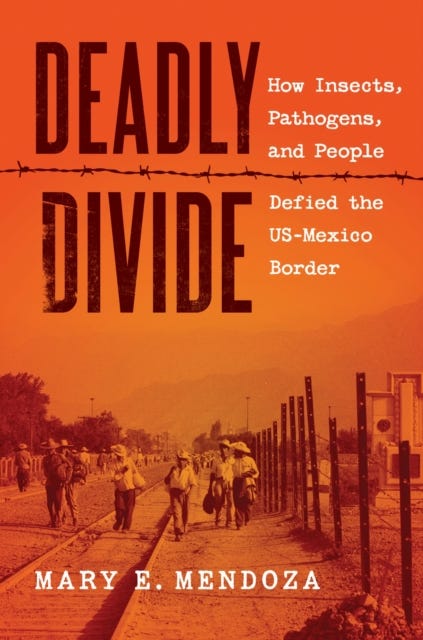
Deadly Divide: How Insects, Pathogens, and People Defied the US-Mexico Border, Mary E Mendoza, 2026, University of North Carolina Press
By Gavin O’Toole
The border between the United States and Mexico is as much metaphysical and political, defined by racist stereotyping, as it is physical through fences.
And as Mary Mendoza demonstrates, inhuman attitudes towards immigrants from the south early in the development of border enforcement derived from perspectives that equated them, literally, with animals.
As the author points out in this eloquent study of policy towards the frontier, what started off as an effort to prevent the movement of cattle-ticks has become an all-consuming idea to control flows of humans seen, in many ways, as vermin.
Deadly Divide: How Insects, Pathogens, and People Defied the US-Mexico Border traces the history of how environmental factors influenced the creation of physical barriers between the two countries.
By dwelling on how the natural world shaped ideas about race, gender and security, Mendoza argues with great originality for unexpected origins of the contemporary immigration debate, not least because Mexican migrants have historically been seen in the US as a form of invasive species.
Deadly Divide shows how cattle ticks, the body louse, foot-and-mouth disease, and the female Mexican fruit fly have unwittingly fuelled the ever-increasing Anglo racialisation of Mexican migrants.
We all know where this has led: to increasingly militarised policing, merciless criminalisation, and toxic moral panics fuelled by complicit media about immigrants infiltrating the US.
In 2018, as a scare tactic US immigration officials oversaw government-sanctioned family separations on a massive scale with some reports estimating that 5,500 foreign-born children, mostly of Latin American descent were detained as part of an aggressive new approach to border enforcement.
In 2025, Immigration and Customs Enforcement (ICE) expanded its draconian powers yet further with very visible raids increasing across the US, some with fatal consequences, as the federal government began the wholesale removal of protections for undocumented people.
Mendoza’s fascinating story begins in 1910 with the United States Department of Agriculture’s (USDA) assessment of the threat posed to cattle north of the border by the so-called Texas fever tick.
Before a tick eradication campaign that began in 1906, the border was mostly an open range—permeable, and marked only by occasional obelisks with little meaning for people and none whatsoever for animals.
Cattle became a metaphor for race, as US ranchers connected national origin with bovine superiority by claiming that their “American” cattle should be exempt from quarantine—the beginning of a “racialisation” of otherwise indistinguishable beasts.
It was this that led to border fence construction beginning in 1911 as a USDA initiative to stop the movement of the tick, and American cattlemen introduced rhetoric that distinguished animals based on the nationality of their owners.
The author writes: “Throughout the tick eradication campaign, cattle ranchers along the border racialized cattle—and later they would extend that characterization to the people who owned them …
“This language resurfaced again and again over the course of the twentieth century … At the same time, Americans’ ideas about the inferiority of all things Mexican—from tick-infested landscapes to animals and later to people—evolved and hardened.”
It is sobering, but not surprising, to learn that the policymaking attitudes in mainstream Anglo America upon which contemporary enforcement against immigration from the south is based began with efforts to keep animals out of the country.
Indeed, it is a metaphor for US racist attitudes towards “others” that are reflected far beyond immigration policy and arguably drive the disastrous destruction that Washington has visited upon far-flung parts of the world with non-white populations regardless of the human cost.
BUY THIS BOOK: UK/Europe