Mutual kingdoms
Nature’s cultural impact is best seen by breaking disciplinary boundaries. Books in brief: Plants and Animals in Latin American Cultural Production
Plants and Animals in Latin American Cultural Production, Cristina E Pardo Porto and Oscar A Pérez (eds), 2025, University of Florida Press
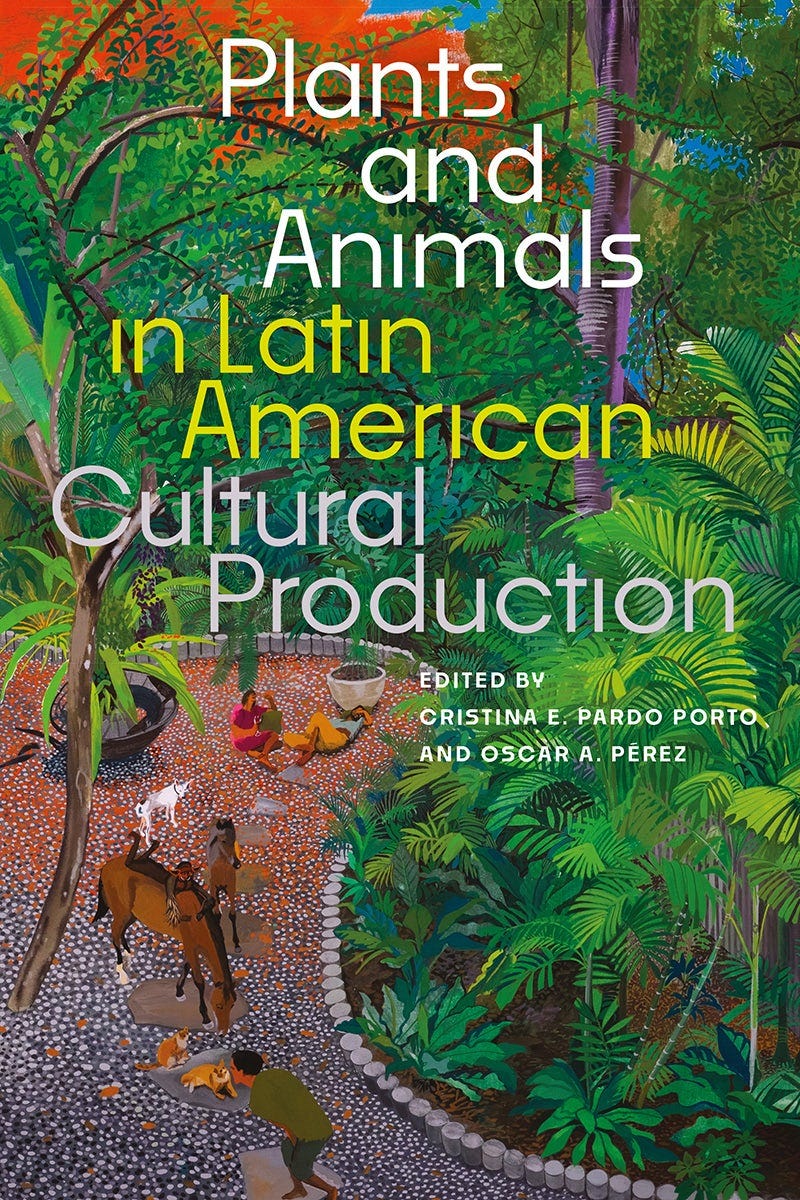
In the rainforests of South America, the striking flowers of the Heliconia not only light up the selva, but provide a unique example of evolutionary mutualism.
These flowers have over millions of years developed curved shapes that match the bill of a specific species of hummingbird, ensuring that only that bird can access their nectar and hence act as a pollinator.
Similarly, there are specific species of tiny wasps which live their entire lifecycle within the fruit of neotropical fig trees that are dependent solely upon them for pollination.
In the dry forests of Central America, some Acacia species have coevolved in a relationship of mutual dependence with specific ants to such an extent that, without the other, neither can survive.
These intimate relationships show us not only how precise nature can be, but also inform human culture: the Maya used Acacia ants to treat depression and as a source of medicinal oil, and the hummingbird is ubiquitous in the spirituality of Latin American indigenous cultures.
Plants and animals have been prominent in the region’s cultural productions for centuries and numerous species in both kingdoms populate indigenous codices, colonial paintings, patriotic art and literature, and even contemporary films denouncing climate change.
Yet as Cristina Pardo Porto and Oscar Pérez note, despite the inseparability of plant and animal relations, their study within the humanities has been largely compartmentalised by that human tendency to specialise knowledge and separate ontological and epistemological research.
While this has been especially the case in cultural criticism, the editors point to a growing interest in bringing the fields of critical plant studies and critical animal studies closer in recent years.
Plants and Animals in Latin American Cultural Production invites readers to reflect on how our cultural understanding of plants and animals changes when we consider them together.
Its aim is to scrutinise the relationships and conflicts that arise between plants, animals and humans, and how these are portrayed in Latin American literature, visual arts, film, and other cultural forms.
There has been no systematic study that explicitly promotes the intersection of these disciplines in Latin America, and the essays in this volume take a radical, holistic approach to exploring the web of relationships among human and non-human living entities.
In so doing, the editors argue, they offer insights into broader societal issues and other ways of living, knowing and communicating as well as the basis for new coalitions crucial for resisting environmental devastation and climate change.
The editors write: “We must move away from anthropocentrism to address global challenges beyond their impact on the human, such as animal or plant extinction. By paying attention to the shared realms of plants and animals, we can uncover new ways of relating to what is around us and foster more sustainable lives closer to a vegetal and animal way of existing.”
Examining themes from colonial to contemporary eras and covering works from the Caribbean, Central and South America, Brazil, and the US as well as Indigenous communities this collection incorporates analyses of film, documentaries, photography, painting, literary texts, and even unconventional formats like cookbooks.
Contributions includes that of Kate Ostrom who focuses on non-human/human solidarity and alliances along the US- Mexico border and in the context of the migratory crisis.
Ana Carolina Carmona-Ribeiro looks at how palms have been active agents shaping Brazil’s modernity in terms of landscape and its relationship to national identity.
Oscar Pérez proposes a grammar to describe more-than-human entanglements based on kinship, intimacy and intellectual humility.
Jorge Quintana Navarrete explores the interrelation between racialised bodies and vegetal life in representations of chicle extraction in Mexico, encapsulating the tensions between plant-human relations and exploitative systems of production.
The highly original contributions that make up this collection break disciplinary boundaries and amplify hitherto marginalised voices—and we have plants and animals to thank for that.
BUY THIS BOOK: UK/Europe ——— USA/Americas

