
Painting pain
Georgina Jiménez assesses how London’s Tate Modern is exploring ‘Fridamania’
Frida: The Making of an Icon. Tate Modern, London. 25 June until 3 January 2027
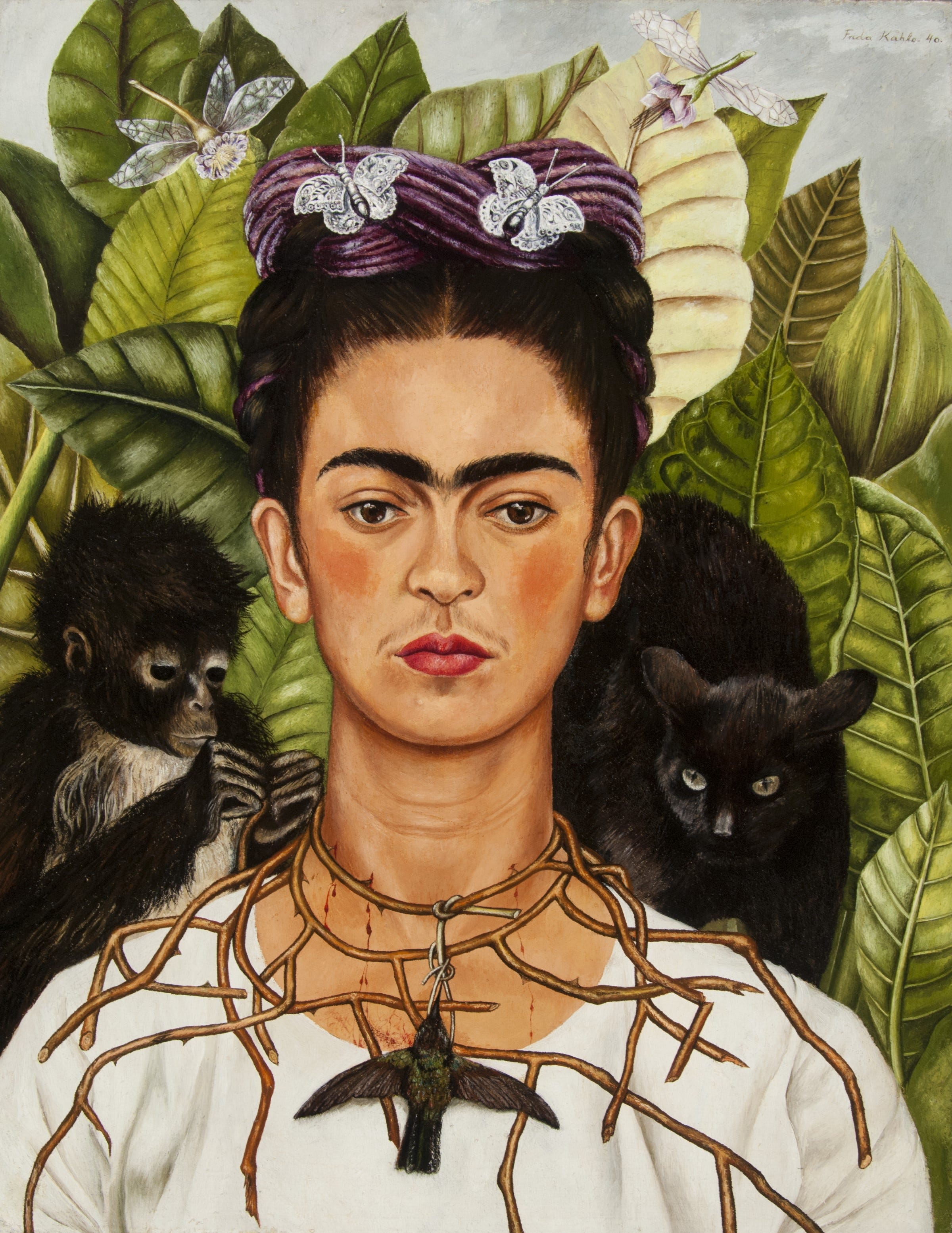
What makes an icon? To answer this it is necessary to immerse yourself in the depths of an artist’s life—but in the case of Frida Kahlo that meant many different experiences.
Of course, diverse experience reflects the human condition, but what has turned Kahlo into the subject of global cultural mania is above all that she understood pain.
Whether physical or emotional, this woman with a broken body survived everything an individual can endure in one lifetime—but would not be destroyed. And the greater the pain, the greater her defiance.
At the age of seven, after she had caught polio, a disabled young Kahlo had to dodge peers’ taunts at school. Her painful leg did not stop her dancing, partying and planting objects mocking the authority of ceremonious monuments, however. She smoked like a chimney, and defied the gender conditioning of her day.
Like Che Guevara, Kahlo has since become the Latin American darling of the masses, the embodiment of “what doesn’t kill you makes you stronger”. Mexico’s unrivalled poster girl.
She saw her world transformed, witnessing the volatility and reconstruction of a country that experienced the first revolution of the 20th century which morphed from peasant backwater to industrial powerhouse. As Mexico explored itself and forged its new identity, she began to understand that the lesson of life is one of change.
Living with chronic pain did not distract her from noticing the daily pains of poor people, taking their side and becoming a member of the communist youth, attending meetings and holding angry placards at marches.
When a disastrous bus crash almost tore her apart, immobilising her for eight months, her spirit reassembled. Her loving father gave her the tools for survival: brushes and paint. Art is the best therapy, and it saved her life.
And as physically restricted as she was, Kahlo bewitched artists and leaders, both men and women. This militant tomboy with a playful smile would meet with peasants during a dangerous era, hiding a pistol beneath her ornate skirts.
She took risks and later would help shelter Leon Trotsky, an exile from Stalinist Russia, who just like her wanted to transform the world and globalise socialism.
As an artist, she possessed bags of talent, even though her work was obscured in the shadow of her husband’s prestige. Added to that, Diego Rivera forced her to rise like a phoenix from the flames of a constantly cheated love.
However, it took a quarter of a century after Kahlo’s death at 47 for feminists debating sexism in art to uncover a plethora of talented women painters. It was her colourful and naïve style, and openness about her personal experience, that made her work particularly fascinating.
Kahlo continues to charm other equal rights rebels, young artists, LGBTQ+ campaigners, Latino migrants, filmmakers and artisans, and in 2025 her work “El sueño (La cama)” sold for $54.7m, becoming the most expensive ever painted by a woman. A true trailblazer.
And nearly a hundred years later we see her face emblazoned everywhere, from T-shirts to Barbies and hair conditioner, unleashing a universal creativity yet sadly—and anathema to Kahlo’s ideas—through commerce. To capitalism, Frida is the gift that keeps on giving.
It is against this backdrop that Tate Modern in London has launched its latest blockbuster exhibition “Frida: The Making of an Icon”.
Spoiler alert: if you expect to find a gallery full of Frida’s own paintings, you may be disappointed, or conclude that the exhibition seems a lost opportunity. “The Making of an Icon” is curated in a way that intends to contextualize Kahlo alongside her contemporaries and new artists, who often create in greater scale.
In the first room the minuscule plaster bodice of Frida “the activist” welcomes the visitor. Is this a gypsum tattoo? It bears her two major wounds: a hammer and sickle and an unborn child.
But rather than revealing to visitors her political statement, it stands alone: visitors pay more attention to her nude photos or the beautiful self-portrait she gifted to her parting boyfriend.
For André Breton, “Mexique” was the place that best embodied Surrealism—and Kahlo’s works were proof of it. Encouraged by Breton, she exhibited in Paris, and some mementos of this exhibition are part of the Tate’s show.
Frida “the foreigner” is put to the visitor through her tiny but highly critical “My dress hangs here”. In this work, created during her brief stay in the United States, she literally “hangs out to dry” her clean and colourful linen, dangling it from two grey and sterile concrete skyscrapers. A toilet crowns one of them, while tiny masses of Mexican campesinos and workers form the the base of the monstruous city.
The message is obvious, after three years in capitalist America you can see my clothes here … but I am somewhere else, It is a shame that this statement has been dwarfed by Mexican American Laura Aguilar’s much larger “Three Eagles Flying”, an excellent photo tryptic, alongside it.
The intimacy of personal objects of Kahlo on display, such as her diary, corsets, a decorated orthopaedic boot, and her “Viva la Vida” painting, which she finished eight days before her death, can be missed among the monumental works chosen by the curators.
Nonetheless, if visitors come with an open mind they will find that the “after Frida” selections in this exhibition are interesting and refreshing, and an opportunity to interact with works by artists that can only be seen in the US or other countries.
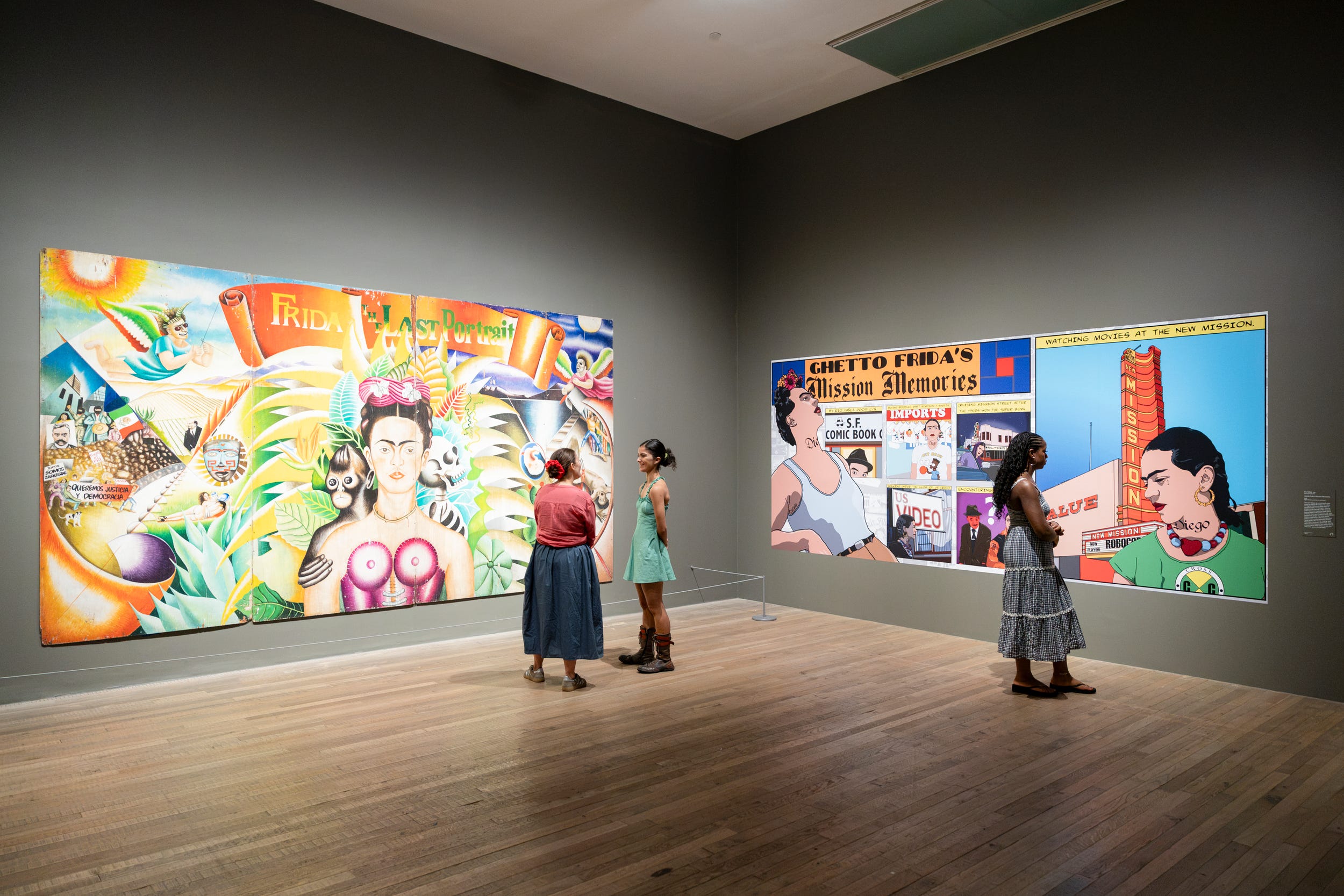
After all, “Frida: The Making of an Icon” intends to showcase how Kahlo’s ripple effect has changed the world of art.
Notable works include the vivid and tortuous “Birth Tear Embroidery 3” by Judy Chicago; “Con todo respeto” is a cheeky nudge to Frida’s “The bus” and about commuter Mexican reality by queer artist Nahum Zenil; “Ghetto Frida’s Mission Memories” by Rio Yañez of Galeria de la Raza, offers a Latinx comic-book take on Kahlo’s life.
Other standout pieces are: “Frida the last Portrait” by Chicano artist Marcos Raya; “Silueta Series, Mexico” by Cuban Ana Mendieta; and the shrine installation “Frida Temple” by Amalia Mesa-Bains.
“Old arguments with indigenism” by Nalin Malani from India join Frida and the artist herself; and “Self-portrait with Frida” by Chinese American Nancy Hom explores identity and family.
Tate Modern’s show coincides with a series of other events across London to celebrate Kahlo in a summer of unrestrained “Fridamania”.
And from the grave her image will keep watching you, maybe expecting that since she is all things to all people she may influence one day the social change she dreamt of.