
Pawns in print
Press ‘freedom’ in Mexico has been shaped by elite ambitions. Review: Mexican Watchdogs: The Rise of a Critical Press since the 1980s, Andrew Paxman, by Gavin O'Toole
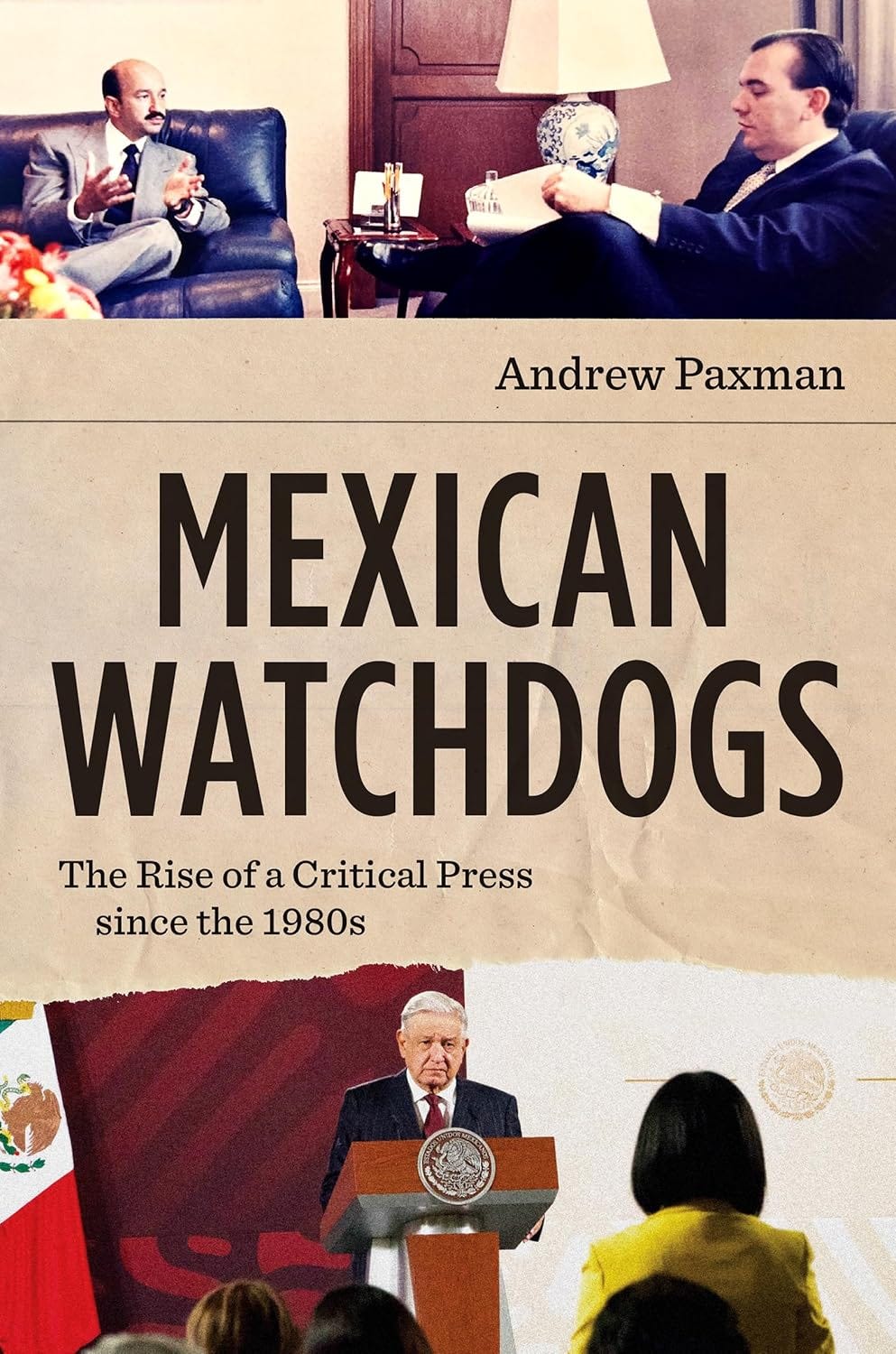
Mexican Watchdogs: The Rise of a Critical Press since the 1980s, Andrew Paxman, 2025, University of North Carolina Press
It is often forgotten that Karl Marx was, first and foremost, a journalist who, despite the blunt implications of his theoretical archive concerning the ideological role of newspapers, was an ardent defender of press freedom.
Marx condemned censorship which, as chief editor of the Rheinische Zeitung in the early 1840s, he ridiculed, and eschewed any notion that the media should be controlled by the state, praising the role of a free press.
However, Marxist theory has also evolved a potent critique of the media as a bourgeois instrument, empowering the control of the ruling class through a dominant ideology and false consciousness, the maintenance of hegemony, and the promotion of consumer fetishism.
What such a bipolar perspective means is that we can simultaneously regard the press as a liberal watchdog capable of holding power to account, yet also see it as part of the critical infrastructure of capitalism, joined at the hip to its political economy.
The latter is clearly in evidence when considering press history, especially one tracing its evolution alongside “democratisation” in the context of challenges to an authoritarian state where media “freedom” is merely an instrument in the hands of a counter-elite.
Such was the case in Mexico during the late 1980s, when the then president Carlos Salinas Carlos Salinas de Gortari (1988–94)—a Harvard-educated technocrat—did more than any predecessor to weaken the links between a single-party statist regime and a media that was corporate in every sense.
Thus, as Andrew Paxman documents eloquently, we see a press that is suddenly unfettered to flourish as a watchdog just as a counter-elite is reshaping the ruling PRI yet then, as the reformed state adapts to the new era of competitive politics, is once again (mostly) humbled.
As Paxman shows, in the 1990s and early 2000s, that period in which power slipped from the PRI’s iron grip, the press became more pluralistic, investigative, critical and, importantly, financially autonomous. Yet after a “spring” of 20 years or so, it has once again been mostly tamed by vested and state interests as its legitimacy has been eroded.
Hence, distrust of the Mexican press soared during the presidency from 2018–24 of Andrés Manuel López Obrador, whose irritation at media scrutiny chimed with that of other populist disruptors, not least Donald Trump.
As Paxman notes in Mexican Watchdogs: The Rise of a Critical Press since the 1980s, the aspersions cast by AMLO on the media eroded any belief that a free press is key to a functioning democracy, while putting journalists in the firing line—literally.
There is much to recommend analysis of the ideological role played by the press in Mexico’s 20th-century history, and the application of the theoretical work of figures such as Ralph Miliband, Antonio Gramsci and Louis Althusser in this endeavour.
All of these Marxist thinkers, in one way or another, alluded to the construction of control and consent in a bourgeois society through what we sloppily call journalism.
That ideological role draws our attention to the non-compliance of a minority of actors determined to challenge official narratives, especially in a country comprehensively shaped by a ruling party literally synonymous with the state itself.
Yet what is arguably analytically more interesting is the relationship between the role of the press and a given political economy—a relationship that surfaces with clarity from the PRI pigswill when, thanks to Paxman’s account, we can examine the historical record.
The author focuses on the period since 1980 but pays attention to its antecedents in the dictablanda, that era of unchallenged PRI hegemony between 1938 and 1968 in which Mexico’s press was fully co-opted by the state through financial incentives.
It was in this period that enduring attitudes about the press were shaped: for generations following the Revolution journalists were considered to be a parasitic caste that lived off bribes from state officials, a captured profession lacking any legitimacy.
Nonetheless, acts of resistance to PRI control in the 1970s—namely at Excélsior under its celebrated editor in chief Julio Scherer—thereafter shaped subsequent developments that would give birth as the 1980s began to three critically important publications: Proceso, Unomásuno and La Jornada.
This was a period in which, first, Mexico’s economy was flooded with cheap capital following the 1973 oil crisis, and then brought to its knees by rising interest rates that would result in the 1982 debt crisis.
In such a climate, political frustrations grew—both within the PRI and outside in the conservative PAN, representing above all else northern business interests—and began to challenge the single-party’s monopoly.
It was a form of bourgeois uprising without the uprising, yet nonetheless set the scene for major changes in political economy during the 1980s as Mexico’s counter-elite embraced the Washington Consensus and neoliberalism to advance their reformation.
Enter the diminutive but canny Salinas, under whom as Paxman points out the recent era of watchdog journalism was, in effect, born.
The author shows how, during the Salinas presidency, a media opening to critical and pluralistic perspectives took a broad hold, nurtured by the youthful president’s political priorities and image consciousness, an economic boom that anticipated NAFTA, a cultural shift at newsrooms, and the appetite of media entrepreneurs.
Paxman writes: “Gutsy newspapers launched and older rivals raised their game. New generations of editors and reporters cut their teeth covering the era’s crises; many of them hailed from the modest end of Mexico’s middle class and, at last, many of them were women. During 1994, the tumultuous year that closed the Salinas presidency, Mexico’s watchdog press came of age.”
In this period, press “freedom” was a byword for a broader Mexican glasnost by which Salinas—the most ideologically coherent executive of the recent era—sought to dismantle bureaucratic statism.
A freer press served, mainly, to inform the ascendant business class about the realities of the state they were challenging, while building consensus about the new neoliberal dispensation among middle-class Mexicans.
At the same time, the logic of neoliberalism, by which economic change is driven by a general gain in efficiency, implied dramatic movement in the activity of media corporations themselves, not least consolidation and expansion.
Paxman goes on to show how, after Salinas, the press matured further during the presidencies of Ernesto Zedillo (1994–2000) and Vicente Fox (2000–06), but that this came to an end under Felipe Calderón (2006–12) whose war on drugs reflected Mexico’s political subordination to the US following NAFTA.
As Mexico succumbed to unprecedented violence by the state, the latter increasingly took control of the narrative through a massive increase in government advertising to co-opt hungry publishers in time-honoured Mexican fashion.
The trend continued under Enrique Peña Nieto (2012–18) and, while some independent journalism flourished, especially online, Paxman writes: “The years 2006 to 2018 in some respects saw a downward curve for press openness, at least in legacy media, as the physical violence wrought by crime syndicates and corrupt politicians and the structural violence wrought by the discretionary allotment or withholding of official advertising undermined hard-won freedoms.”
AMLO’s presidency reflected less a “fourth transformation” as he was wont to describe his policy ambitions, as a dramatic change in the global character of neoliberalism, by which democracy itself has become an inconvenience to vast transnational corporations.
This, above all else, explains the return of the state’s appetite to control a narrative subordinated slavishly to the priorities of a new, techno-feudal oligarchic source of capital and served up by a corporate media that, in many cases, they also own.
Mexican Watchdogs is a brilliant narrative history that lends itself well to such analysis, written by a scholar who has more insight than most, having been a newspaper journalist on the very organs that he has written about.
Paxman is a rare find, writing with great authority about his topic yet in an accessible and lucid style. If he has adopted an empirical, liberal approach to press history, this does not detract from what we can take away from his chronicle.
Indeed, the author himself offers an intriguing but realistic vision of bifurcated Mexican media consumption in the future comprising “the well-informed wealthy and the ill-informed rest”.
In the spirit of Marx the journalist, Paxman concludes: “Like many countries, Mexico risks regressing toward a society akin to eighteenth-century Europe, in which an elite pays for reliable information, written and edited by specialists, and the large majority contents itself with a freely available mix of unfiltered reports, polemic, and rumour.”
*Please help the Latin American Review of Books: you can subscribe on Substack for just one month ($5) or, if you like what we do, you can make a donation through Stripe or PayPal (send your PayPal contributions to editor@latamrob.com
Fantastic review that really nails how press freedom in Mexico was less about democratic principles and more a tool for the counter-elite to advance neoliberal reforms. The point about Salinas using media opening to build consensus among the middle class while dismantling bureaucratic statism is spot on. I've seen similar patterns in other Latin American contexts where liberalization of media coincided with economic restructuring, and it always turned out the 'freedom' was pretty selective abuot what narratives got amplified.
Many thanks indeed for this generous review, Gavin. Much appreciated.