
Peace betrayed
The insecurity of campesinos is fuelling violence in Colombia. Review: Governing the Excluded: Rural Livelihoods Beyond Coca in Colombia’s Peace Laboratory, Alex Diamond
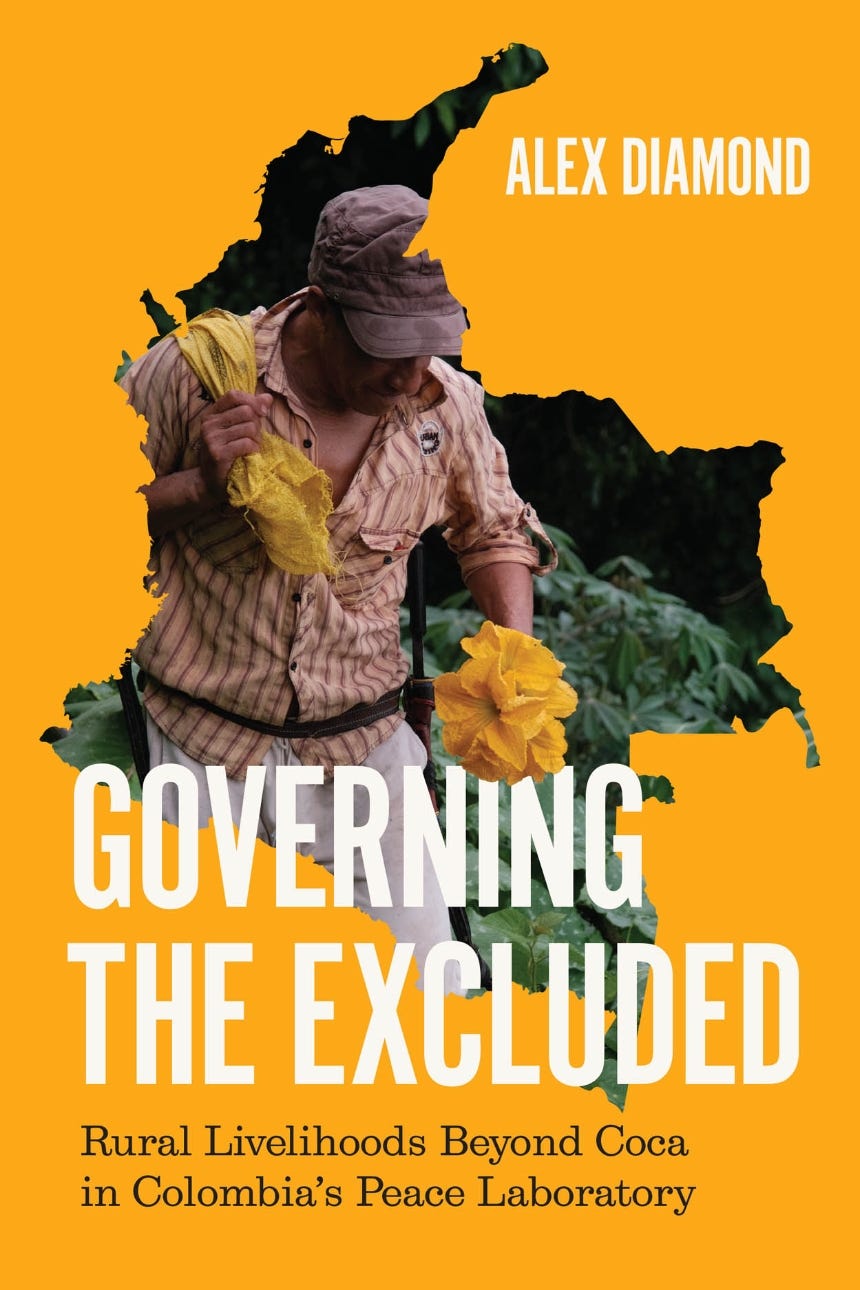
Governing the Excluded: Rural Livelihoods Beyond Coca in Colombia’s Peace Laboratory, Alex Diamond, 2026, University of Chicago Press
By Gavin O’Toole
Colombia’s “peace dividend” has proven to be an illusion, failing to prevent the growing violence overshadowing crucial elections for a successor to Gustavo Petro.
Such is the level of political polarisation in the country that a spike in armed activity has emerged as the dominant campaign motif, likely to determine Colombia’s future for years.
Petro, himself a former guerrilla, became president in 2022 promising to win “paz total” (“total peace”) by signing deals with a spectrum of armed groups including leftwing rebels, rightwing paramilitaries and criminal cartels.
Four years on, however, guerrilla violence, murders, kidnappings and massacres have soared, reviving traumatic memories of Colombia’s long civil conflict that claimed half a million lives.
In short, the May 31 presidential election will decide whether Petro’s security strategy—to negotiate with remaining armed groups in order to address the deep-rooted causes of violence—survives or is dismantled.
While current insecurity offers ammunition to Petro’s rightwing critics and a newly aggressive US as ostensible proof of the failure of the left, the truth is that 2016 peace deal between the government and the FARC was faltering long before he came to power.
Petro’s main failure has not been to keep a lid on the violence, but the scale of his promises—over-ambitious and unrealistic, especially given the foot-dragging of preceding presidents.
The administration from 2018–22 of the rightwing Iván Duque—who had personally opposed the peace agreement with the FARC—was particularly catastrophic for sowing the seeds of current discord.
Duque weakened the Special Jurisdiction for Peace, cut the budgets of the Truth Commission and the body searching for the disappeared, promoted generals responsible for extrajudicial executions and halted talks with the ELN, now the largest armed group in Colombia.
Moreover, much of what Duque’s government did in terms of economic policy was guaranteed to weaken what little progress had been made providing those in the countryside hitherto lured to join armed groups with alternative, legal livelihoods.
In a major betrayal, Duque explicitly tried to limit the scope of the 2016 deal strictly to the disarmament of the FARC, and intentionally frustrated its transformative rural economic aspects by withdrawing political will and slashing budgets.
That has meant that the structural economic reforms aimed at transforming rural Colombia under the peace agreement have only been partially implemented, have faced long delays, and have failed to meet targets: independent observers estimate only about a third of the overall accord has been carried out.
Above all, Colombia’s government has failed to make progress on the comprehensive rural reform to return stolen land to smallholders that was at the heart of the accord. Financial and infrastructure support to enable smallholders to move away from illicit coca cultivation has lagged badly, and many farmers have simply returned to the status quo ante.
Alex Diamond’s Governing the Excluded: Rural Livelihoods Beyond Coca in Colombia’s Peace Laboratory underlines the fact that deals with armed groups in themselves are never enough to achieve meaningful peace—in short, implementation is everything.
In a timely and valuable work, Diamond provides evidence of the precarious calculations that those on the frontline of Colombia’s endless insecurity have to make as part of their survival strategies.
His book addresses three critical questions that are at the heart of so-called peace processes: why do they succeed or fail? How is the authority of the state established? And why do people participate in drug economies and join armed groups?
The answers he provides to these are uncomfortable—but hardly surprising.
The author uses the case study of Briceño—a community in northern Colombia thrust into the national spotlight as the so-called “peace laboratory”, where agreements under the 2016 accord were meant to bring visible peace and prosperity.
He finds that while the region has been transformed, with relative tranquillity, fields free of coca, new roads and schools, and Colombia’s largest hydroelectric dam, peace has not lived up to its promise.
The local economy has collapsed because of the disappearance of coca, the dam has destroyed traditional economies like gold panning, and agricultural policy has exposed vulnerable farmers to competition from agro-industry and imports that drive prices low.
As a result, the community is turning to two forms of authority for resources essential to meet everyday needs: the state itself, purporting to be the harbinger of a new, prosperous peace; and its alternative, in this case a dissident FARC group that has rearmed in the region and that encourages disgruntled locals to plant coca again.
As the author notes, Briceño is a microcosm for a fraught relationship more globally between peace, state formation and economic development, buffeted by issues of agrarian transformation, national political struggles, and international drug economies and the US-led War on Drugs that seeks to dismantle them.
His main argument is that, using Colombia as an example, the exclusion of poor farmers from legal markets is transforming the nature of authority across the Global South, potentially establishing either state or anti-state governance, with all the consequent violence.
At the heart of this issue is a globally dominant economic model, and the weakness of countries like Colombia in their ability to protect domestic producers from the impact of “free trade” agreements negotiated with the world’s most powerful capitalist states.
To his credit, Diamond admits to his enthusiasm at the potential offered by the election of Petro in 2022, asking if his administration could reconfigure Colombia’s place within global agricultural economies to open space for smallholder production and put the brakes on a decades-long shift to extraction.
These are without doubt, however, long-term objectives—and in the meantime families have to feed themselves.
The Petro administration has clearly tried, nearly tripling the federal budget for agriculture, halting new contracts for gas, coal, and petroleum exploration, and launching initiatives to facilitate campesino access to credit and subsidised agricultural goods.
Yet in time-tested fashion, its efforts have been frustrated by conservatives at almost every turn, by the rapacious demands of Washington on behalf of insatiable US investors, and by the international financial architecture that continues to blight the dependent South.
Other reforms of the Petro administration have been blocked by Colombia’s rightwing opposition in congress, and the IMF has used loans and the US has used military aid to persuade the country to open its economy to international capital.
In Briceño, the response of campesinos has not necessarily always been to return to coca, but many are resuming illegal and environmentally destructive gold-mining under the authority of armed groups.
Diamond writes: “Unable to find stable wage labour or compete with industrially produced food crops, the poor cast a wide net as they struggle to subsist and build a better future for their families.
“As part of these struggles, they engage state and alternative authorities who provide needed resources and services to generate loyalty, wealth, and power.
“These engagements, rooted in needs left unmet by legal markets, provide the basis for poor people’s relationships to those who would govern them—and alongside it, the chances for subduing or intensifying internal conflict.”
The stakes are high, and if the left loses in the coming elections it is likely that Colombia will have to endure the return of an extreme rightwing government set on revitalising a traditional security alliance with the US where guns displace talks in the pursuit of peace.
Worse, Colombia’s atavistic right would almost certainly strengthen the traditional control of the ruling class over land and natural resources, and related extractive financial, commercial, and drug-trafficking activities—inevitably fuelling yet more bloodshed.
BUY THIS BOOK: UK/Europe
An interesting take on the crumbling Colombian peace process. Peace never happens in a day, it takes time to establish, and it is never perfect, certainly not in the beginning. It requires sacrifice and a lot of trust, which only comes with time. Sadly, the Duque administration had little desire to frankly engage with the process, and they spent four years dragging it out until it suffocated from a lack of political will. Of course, dissident factions refused to engage with the process, adding to its fragility, but that only increased the imperative to continue building peace. Countless civil rights activists have been assassinated since, removing vital voices for peace. Narcotrafficking fills the void left by the state. Paz total was overly ambitious bordering on naïve, and has only served to further weaken any faith in non-violent action. A true missed opportunity.