
Revolutionary tales unearthed
Mexican and Cuban stories translated by Langston Hughes make a radical debut. Books in brief: Troubled Lands: Stories of Mexico and Cuba
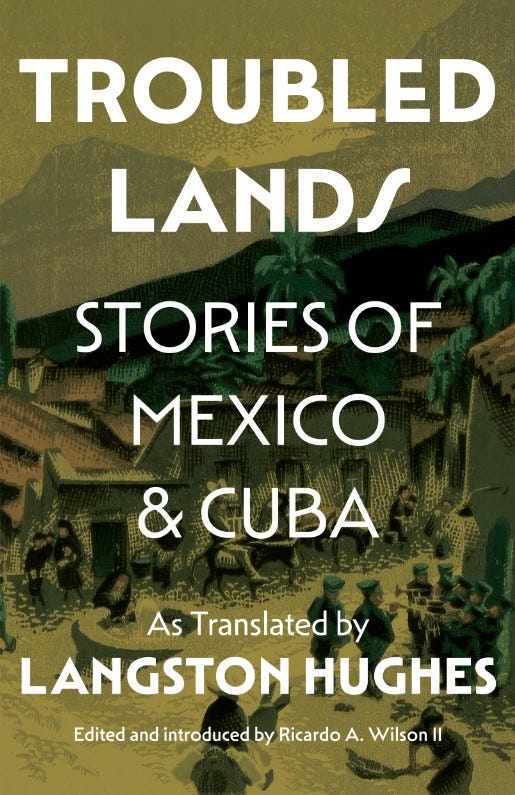
Troubled Lands: Stories of Mexico and Cuba as Translated by Langston Hughes, ed. Ricardo A Wilson, 2026, Princeton University Press
By Gavin O’Toole
The biography of the writer Langston Hughes naturally tends to focus on his role as a champion of Black radicalism within the US and to sideline his peregrinations in Mexico.
However Mexico, and Cuba, were profoundly important influences upon his writing, life and political views and deserve a more prominent place in the study of his archive.
Ricardo Wilson provides an excellent summary of these in the introduction to Troubled Lands, an important collection of short stories translated by Hughes but one that his own literary agent discouraged him from publishing.
A novelist, poet, playwright, columnist and social activist originally from Missouri, Hughes is perhaps best known as a prominent figure behind the Harlem Renaissance, the African-American intellectual and cultural movement of the 1920s and 30s.
Nonethless, he spent significant period in Mexico, visited Cuba, and in the early 1930s travelled to the Soviet Union with a group of Black artists and activists where he became interested in translating the poetry of, among others, Vladimir Mayakovsky.
This collection of short stories is a landmark—the first complete publication of Hughes’s translations from the Spanish of 33 stories by 18 Mexican and Cuban writers.
It derives from a particularly fertile period in Mexico after 1934 where he spent time with his friend José Antonio Fernández de Castro, a Cuban journalist and important literary figure working at his country’s embassy in Mexico City.
In this period the Mexican capital was a cauldron of leftwing ideas and a magnet for cultural figures, and among the acquaintances made by Hughes were the Zapotec poet Andrés Henestrosa and the photographer Henri Cartier-Bresson.
As Troubled Lands began to take shape, Hughes explained in letters to friends how this Mexican and Cuban short fiction spoke to “the revolutions and uprisings, sugarcane, Negroes, Indians, corrupt generals, American imperialists—mostly all left stories, because practically all the writers down here are left these days.”
As Wilson points out, his work in this period “not only mirrored the changing nature of his own literary output but very much aligned with the politically active life he had been leading—from his public and vocal defence of the nine Scottsboro Boys falsely accused of raping two white women in 1931 to his consistent campaigning for the jailed Communist Haitian poet Jacques Roumain.”
The stories chosen and translated by Hughes all tapped into the zeitgeist of revolutionary possibilities that had since the 1920s been championing the struggles of the common man.
As Wilson notes, one reason he was discouraged from proceeding with it by his agent was that, by 1935, the theme was tried and tested, with the authors chosen for the collection attempting to recapture the mood already established in such works as Mariano Azuela’s Los de abajo (The Underdogs), first published in translation in 1928.
Another was clearly the racial context that posed significant obstacles to a book of international leftwing stories edited by a Black author as prominent as Hughes in a media industry dominated by white bourgeois editors.
A third, and equally plausible possibility is that Hughes’ literary agent, Maxim Lieber, was trying to protect himself and his client, of whom he thought highly.
Lieber was squarely on the radar of those in the US security and political establishment who would unleash the anti-communist witch-hunts, and in 1950 was summoned by the House Un-American Activities Committee (HUAC) whose members had already identified Mexico as a hotbed of Communist thought.
Hughes was himself accused of being a Communist by many on the right, and in 1953 was called before Joe McCarthy’s Senate Permanent Subcommittee on Investigations during which he was confronted by lines from his most radical poems.
This experience was so traumatic that he thereafter distanced himself from the radical left and overtly political poetry, earning criticism from previous fellow travellers.
Although Troubled Lands brings together stories from Cuba mostly written in the aftermath of the Machado regime as the brutality that would distinguish the regime of Fulgencio Batista was germinating, a key shared theme with Mexico is labour.
In Cuba, Pablo de la Torriente-Brau’s “We Alone”, for example, casts labourers as “warriors of work” oppressed by their exploitative employers, and Arturo Ramírez’s “Hatred” considers the rapacious ambitions of capitalism under US de facto control of the island.
In Mexico, José Mancisidor’s “Home” explores the personal tragedy underpinning US-Mexico labour migration; and Germán List Arzubide’s “Greetings, Comrade” highlights the rise of Communist activism in the countryside.
Yet the Mexican Revolution looms large, as does the influence of Azuela, and key characters and events from the period of fighting and its aftermath litter these stories.
Rafael Felipe Muñoz, for example, relates an encounter between warrior women supporting government troops and savage rebels, uisng their harsh fate as a harbinger of the disaster of war.
This and other themes in the book will resonate today, especially in the US, making Princeton’s release of this collection both timely and welcome.
BUY THIS BOOK: UK/Europe