Rocket men
Cuba’s nuclear brinkmanship contains lessons about imperialism and internationalism. Review: The Fate of the Americas, Renata Keller, by Gavin O'Toole
The Fate of the Americas: The Cuban Missile Crisis and the Hemispheric Cold War, Renata Keller, 2025, University of North Carolina Press
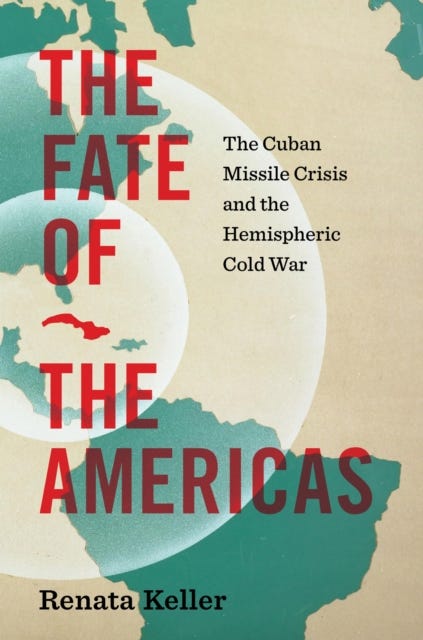
The Cuban missile crisis of October 1962 may today seem like ancient history, but it continues to offer resounding lessons about Latin America’s experience with imperialism and the limits of international solidarity.
As US forces gather off the Venezuela’s coast to illustrate renewed interference by Washington in the region, the Cold War confrontation that took the world to the brink of nuclear Armageddon reminds us of hard truths confronting progressive forces.
Renata Keller’s brilliant history of the crisis and analysis of its consequences identifies these in forensic detail—and they make for difficult reading on the Left which, when the dust settled, would pay a bloody price for Cuban and Soviet folly.
It’s a timely book, because the real target of Trump’s military deployment in the Caribbean today is certainly not drug-trafficking in Venezuela—or possibly even the scalp of its president Nicolás Maduro—but regime change in Cuba.
The island’s revolutionary regime remains the nemesis of secretary of state Marco Rubio, whose parents were Cuban exiles and who is shaping up to be the Rasputin behind the imperial throne.
Experts believe Rubio, through his useful idiot in the Oval Office, sees ousting Maduro in Caracas as a prelude for what he has wanted all his life: regime change in Havana, 65 years after the Kennedy comic duo made that their own priority.
By sending warships to Venezuela’s coast to spook Maduro, Rubio is quite literally testing the waters.
Keller’s The Fate of the Americas is a remarkable historical reassessment whose premise lies in its title: whilst our understanding of the Cuban missile crisis is conditioned by the confrontation between superpowers, it was in fact very much a hemispheric affair.
Keller has researched the impact of the 13-day standoff—one of the most important events in 20th-century history—beyond the US and Soviet Union to explore its Latin American consequences.
As she shows, these influenced the course of regional history and inter-American relations for decades to come.
The impact was profound and enduring: when more than 200 million Latin Americans learned on October 22, 1962, that they were living in the shadow of nuclear missiles located on Cuba, this news set off an explosion of activity.
Mexico and Brazil pleaded with Fidel Castro to give up the weapons; Argentina sent ships north to join the Inter-American Quarantine Force in the Caribbean; people spilled into the streets of Bolivia, Colombia, Peru and Argentina calling for peace or war; demonstrations erupted in Nicaragua, Panama, Costa Rica, Ecuador, Chile, Uruguay, and Brazil; saboteurs in Venezuela and Argentina set fire to oilfields and torched US-owned businesses; and protesters in Uruguay, Bolivia and Brazil battled armed police in deadly clashes.
Indeed, as Keller points out, Latin America was at the heart of Cuba’s missile crisis from the outset because the people of the region were already participants in both the island’s revolution and the growing forces of counter-revolution.
And that is probably the first major lesson of this period, what the author calls a “tragic irony”: rightwing forces throughout the Americas trying to weaken Castro—including Cuban expatriates such as Rubio’s parents—inspired the Soviets to offer him the deadliest weapons of all to defend himself.
In a comprehensive examination of what unfolded, Keller explores how Latin American people and governments sought to resolve an existential crisis in their vicinity.
The Organization of American States, for example, coordinated a united front across the hemisphere, while the United Nations engaged with Cuba in a frantic bid to cool escalating developments.
Castro felt empowered by demonstrations of Latin American solidarity as rumours of an imminent US attack on Cuba grew, while behind the scenes John F Kennedy and Nikita Khrushchev played a game of geopolitical chess with cataclysmically high stakes.
While the historical record about what happened next has been researched extensively— Khrushchev blinked and bowed to US threats by agreeing to remove the weapons without informing Castro—Keller provides significant added value by exploring the fallout, and it was era-defining. Latin America would never be the same.
The author demonstrates that the principal victim was international leftwing solidarity, with the outcome exacerbating divisions on Latin America’s already fractious left.
Many who had previously celebrated Castro’s nationalistic zeal now condemned him for having entrusted Cuba’s security and sovereignty to a power that, it turned out, had behaved like a self-serving empire.
Dismay, disillusionment and doubts were sown among other leftwing forces by Khrushchev’s decision to abandon Havana, and questions would fester in years to come about whether the Soviets could be relied upon for political support.
Keller quotes the Brazilian Leonel Brizola, governor of Rio Grande do Sul state (and brother-in-law to the president João Goulart) whose initial support for Havana gave way to the belief that the Soviet Union was taking advantage of the Cuban people’s fight for liberation to make its own Cold War gains and that Castro had been unwise.
Across Latin America, leftwing forces echoed these sentiments, something gleefully celebrated by US officials, the CIA and the US Information Agency in cables and memos.
Khrushchev’s sudden, unilateral retreat damaged Soviet standing in the region and propelled Maoist dissidents within local communist parties into the growing embrace of China—one of whom would be a young philosophy professor named Abimael Guzmán.
The minor chair of a minor regional communist party committee, in 1970 Guzmán would form a new party called Sendero Luminoso, Shining Path, which would become the most violent and influential Maoist guerrilla group in Latin American history.
Such affiliations did not go unnoticed in Beijing, and extensive Chinese efforts to increase its soft power in Latin America and make friends in high places date from this period.
One of those friends was probably Che Guevara, deeply frustrated at what he saw as Soviet betrayal, who was openly courted by Chinese diplomats and became increasingly outspoken about Moscow’s policy towards liberation movements.
Keller writes: “Che Guevara—hardly a fan of the communist old guard or the Soviet policy of peaceful coexistence before the missile crisis—took the outcome as confirmation that Latin American and other Third World revolutionaries had to chart their own path.”
Sensing this change in the weather, and seeking to repair its badly damaged ties with Havana, Moscow leaned into the Cuban policy of supporting Latin American communist parties that opted for armed struggle—a key shift that would help to explain the subsequent scale of insurgency in following decades.
Keller writes: “Supporting violent revolution in Latin American was thus a significant concession to the Cubans—who had been encouraging armed struggle in the region since 1959—and a desperate attempt to retain influence among disillusioned Latin American communists.”
Nonetheless, Moscow’s view of Cuba’s revolutionary regime had also been tainted by the crisis, exemplified by the progressive loss of confidence in Castro by Anastas Mikoyan, sent by Khrushchev to Cuba to repair relations.
Incessantly hectored by Castro and Che on the historical resonance of Moscow’s dramatic failure to undermine Cuba’s struggle for national liberation, Mikoyan eventually grew tired of the barrage of criticism.
Exasperated, he decided that Cuba’s leaders were unreliable allies and drew a line: he made a unilateral decision on behalf of the Soviet Union to withdraw tactical nuclear weapons still secretly in Cuba that Kennedy knew nothing about.
Events also put the apparent rift between Castro and Che into relief, helping to explain the latter’s subsequent guerrilla odyssey in Africa and then South America, where he died, as the de facto exile that it was. If the outcome of the missile crisis was ultimately to prevent a US invasion of Cuba, it left the island—and particularly Castro—isolated.
At the same time, the US reaped a diplomatic windfall from Latin American countries with their own revolutionary legacies hitherto resistant to closer ties, such as Mexico and Bolivia, while deepening antipathy to the Brazilian administration under Goulart, who had defended Cuba’s national sovereignty throughout.
Goulart would be ousted in a military coup in 1964 openly backed by the US that put the seal on Washington’s new ideological obsession with “national security”—another product of the Cuban confrontation—as a guiding dogma for a region it steered into dark authoritarianism.
It is another example of the importance of Keller’s reflections on a turning point in Latin American history, and the author has written an important book that will reshape our understanding of a moment when everything changed for the revolutionary Left once inspired by a vision of internationalism in the struggle against imperialism.
Keller writes: “The Cubans learned a hard lesson, that Soviet solidarity had its limits. They continued to work with and rely upon the Soviet Union, but they would never again entrust their fate so completely to another country.”
*Please help the Latin American Review of Books: you can subscribe on Substack for just one month ($5) or, if you like what we do, you can make a donation through Stripe or PayPal (send your PayPal contributions to editor@latamrob.com


Nothing is ever given without the giver's interests. If soviet cooperation has its own limits so does every other big power right now on the world stage then what's the way ahead for the world for small nations and for global giants?
Truly humbled by your response.It means a lot for me.
.