
The short-lived utopia
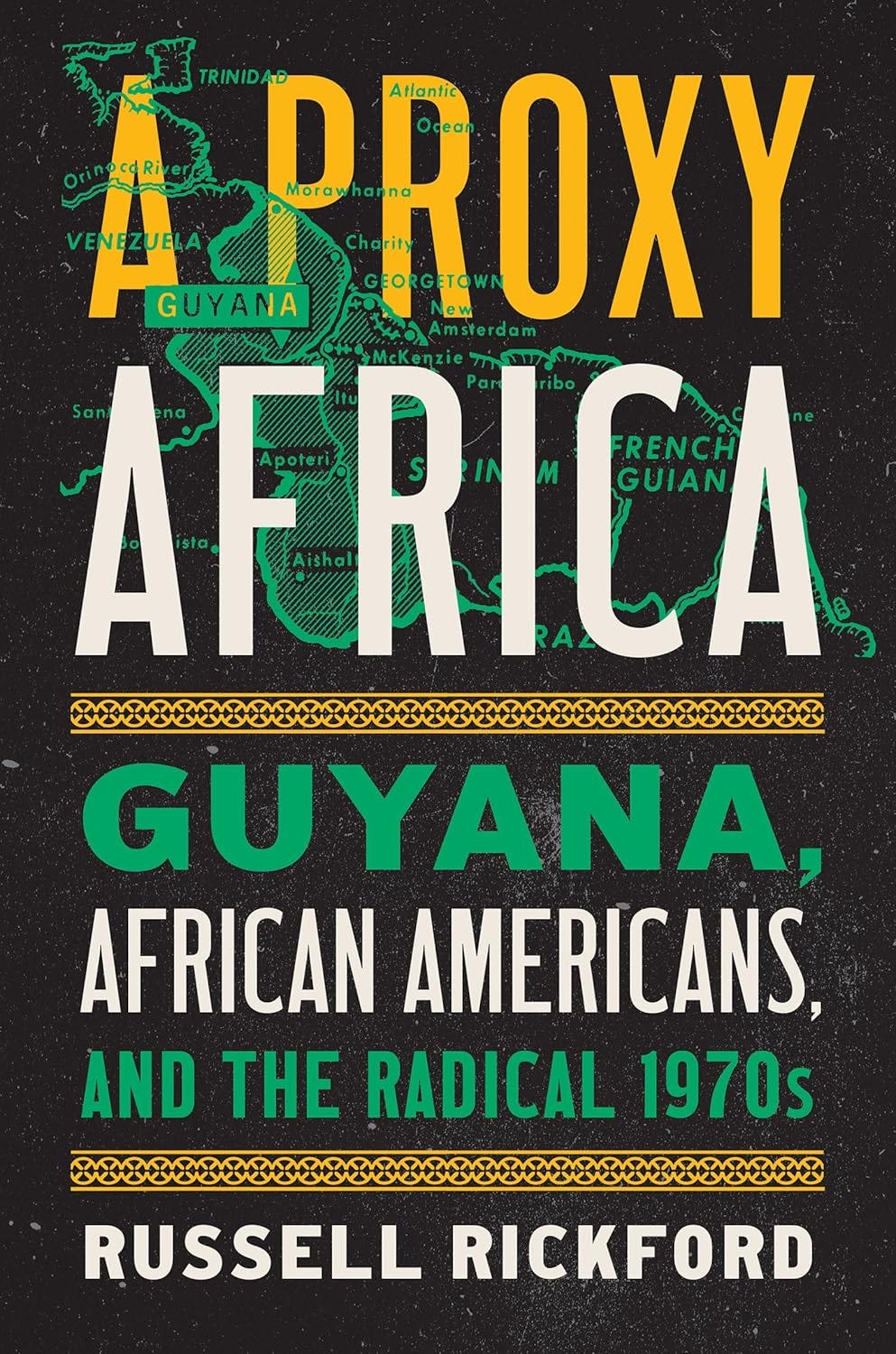
Guyana once provided revolutionary hope for African Americans. Review: A Proxy Africa: Guyana, African Americans, and the Radical 1970s, Russell Rickford
A Proxy Africa: Guyana, African Americans, and the Radical 1970s, Russell Rickford, 2026, University of North Carolina Press
By Gavin O’Toole
If ever the term “sell-out” could be applied to a country that sits within the South American continent, it would be modern Guyana.
This oil-rich, English-speaking state of just one million people—one of the least densely populated nations on Earth—has become the willing neocolonial boot boy of Trump’s revived Monroe Doctrine.
The simple reason for this, as ever, are the riches offered to its elites from extraction of its principal resource, oil, control of which is being passed rapidly into the hands of US oil majors with a direct line to the White House.
The levels of ExxonMobil’s involvement in the oil sector—and subsequent domination of the country’s entire economy—alongside other US corporate and strategic interests are entirely consistent with the model of a “captured state”.
Indeed, the most widely ignored aspect of US intervention in neighbouring Venezuela had nothing to do with its stated motives of narco-terrorism, or even to rid it of political authoritarianism, but to protect American oil interests in Guyana.
Washington intervened directly after Venezuelan naval threats to US-operated platforms in disputed waters and against the backdrop of pledges by Caracas to take over the Essequibo region that it has long claimed but that Guyana clings on to from behind its colonial shield.
In such a context, the term sell-out applies with particular relevance—because Guyana was once seen by black American radicals as a beacon of hope in the wider struggle against imperialism to such an extent that many regarded it as “a proxy Africa”.
Russell Rickford’s study of the same name traces the story of the brief “golden age” of Guyanese Pan-Africanism when a host of African American artists, writers, and activists viewed the young republic as a surrogate Africa in the Western Hemisphere.
He shows that from roughly 1968 to 1980, the poor, underpopulated nation captured the imagination of internationalists throughout the black diaspora and was a destination of pilgrimage for those who wished to support the country’s postcolonial development.
He traces how, in the wake of the turbulent 1960s, US Pan-Africanists, revolutionary black nationalists and other ideologues flocked to the former British colony to work on agricultural cooperatives, expand political networks, and participate in nation-building.
The timing was auspicious: Guyana’s pursuit of Pan-Africanist and socialist policies crystallised just as a generation of black dissidents in the US looked to overcome the fading hopes of militancy at home and craft a science of revolution in the Third World.
Guyana’s first prime minister, Forbes Burnham, granted African American militants sanctuary as political repression within the US was growing.
But as shown by the fact that Guyana’s elites today are turning it into the closest example South America now has to a formal US colony, this is a story rife with contradictions.
Black nationalists and pan-Africanists, for example, insisted on pursuing an identity for this fledgling nation as a black, African homeland, even though South Asians comprised a demographic majority.
This ethnic faultline continues to divide Guyana’s population and hence weaken its sovereignty in a way that is highly convenient for the US to exploit.
The paradox, of course, is that almost from the outset of Guyana’s independence in 1966 it was under pressure from Britain and the US to swallow its subordinate neocolonial status.
US authorities regarded Burnham, for example, as a moderate alternative to Guyana’s Marxist-Leninist politician, Cheddi Jagan, and so backed and financed the prime minister’s government behind the façade of his anti-Western positions.
Rickford’s study paints a picture of a period of radical anti-imperial optimism in Guyana that may have been short-lived, but was immensely hopeful, while providing a valuable survey of the development of Pan-Africanism in the country and abroad.
This hope has contemporary relevance, by revisiting the potential that exists within the notion of diaspora and reassessing the fertile terrain within South America of solidarity in the search for alternatives to capitalism imperialism.
The author writes: “Guyana’s rise in diasporic consciousness underscores the revolutionary optimism that outlasted the 1960s. For a time, the cooperative republic appeared to be the latest ‘African’ territory to straighten its back on the stage of history.
“Affinity for Guyana reflected faith in functional Pan-Africanism and Third World socialism, as well as the notion that self-emancipated subjects from both industrial centres and the global periphery could collectively forge a just order.”
BUY THIS BOOK: UK/Europe