
The subversive flower
A Fresno writer takes Chicana poetry in a new direction. Books in brief: Kadupul Flower, poems by Kimberly Vargas Agnese, by Gavin O'Toole
Kadupul Flower, poems by Kimberly Vargas Agnese, 2025, Green Writers Press
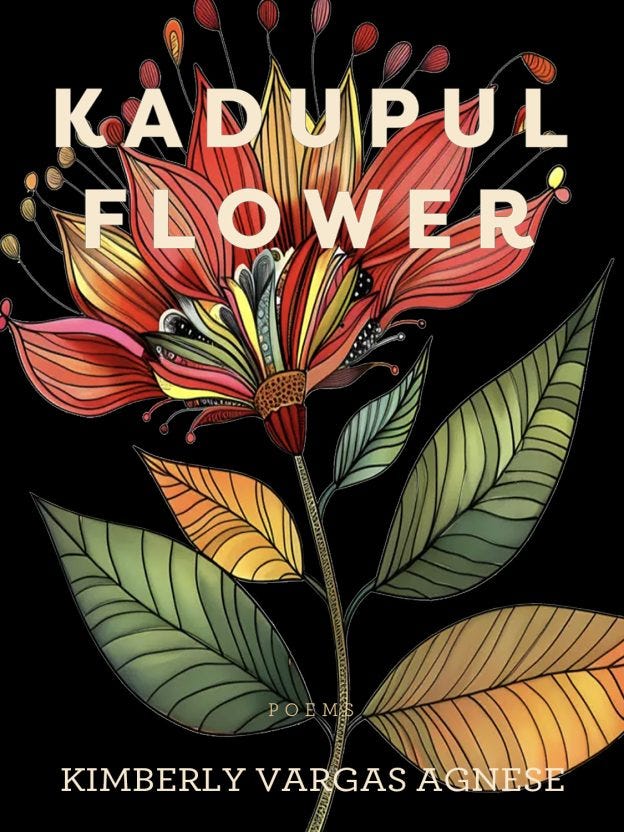
Have you noticed the golden nuggets buried in the soil contemporary Chicano/a poetry, as if these writers have a third eye for the gleam in contemporary American life?
The poems of Kimberly Vargas Agnese encapsulate this eloquent fascination for the commonplace—from everday foods to price tags—that takes the reader straight to the interface between retina and mind.
She tells us for example:
For $4.95, you can get four seedpods at Howard Johnson’s
put them next to a plate of spaghetti, stuff them into your/pocket,
whisper “magic” in the backseat of your mom’s Nova.
(Orange is Symbolic of Wirikuta)
and
With the last $5.48 left on our food stamp card,
I can buy masa and lard to make chochoyotes that should stretch us 'til Thursday.
(Kadupul Flower)
In this case, however, her observations are often about our juxtaposition with the land and how it gains a status almost sacred that derives from her rich inheritance in the arroyos of Mexico.
Many of the characters in her stories are migrant fieldworkers punctuating the hard graft picking tomatoes and corn with soft smiles and kindness in fields exhausted by human machinations. She writes for example:
His thoughts fall into cracks where foremen talk on cell phones
and rednecks toss greasy sandwich wrappers
and go-back-to-Mexicos out of white-boy trucks.
(Rape of the Land)
These may be memories, but it does not matter because we are warmed by the wealth of perception she has for small things. Hers is a Mexican world of generous feelings that subvert the hard American landscape.
Born in Florida, Vargas Agnese has spent much of her life in Fresno, California, where she has worked as a special educator, a youth pastor, and a literacy coach and which, as her poetry makes clear, is a microcosm of resilience in turmoil.
Her work has been featured in publications such as Anacua Literary Arts Journal, The Seventh Wave, Awakened Voices, Rappahannock Review, and The Clay Jar Review. She was a finalist for the 2022 Andrés Montoya Poetry Prize, awarded biannually by the Institute for Latino Studies at the University of Notre Dame.
Her debut collection, Kadupul Flower, is permeated by the power of dignity in the face of America’s most pressing problems, from the precarious condition of the migrant to broader ecological threats.
It hints with refreshing candour at the common origin of social problems in a polluting capitalism and the erosion of humanity that this encourages, while alluding to our ability to blossom unseen (at night) just like the Kadupul flower itself. She writes for example:
Maybe Phil, whose hair is the color of the streets he sweeps,
was right when he said that it would be nice
if we’d all offer to share our garbage cans with each other
You know, act like neighbors
(Notes from a Neighborhood Meeting)
It is refreshing for a Chicana poet to extend the exploration of identity to broader and more urgent natural and social themes, and the work of Vargas Agnese overflows with potential.
*Please help the Latin American Review of Books: you can subscribe on Substack for just one month ($5) or, if you like what we do, you can make a donation through Stripe