
Vernacular neoliberalism
The impact of the Tren Maya challenges academic narratives about Indigenous politics. Books in brief: Roads to Prosperity and Ruin, Fernando Armstrong-Fumero, by Gavin O'Toole
Roads to Prosperity and Ruin: Infrastructure and the Making of Neoliberal Yucatán, Fernando Armstrong-Fumero, 2025, University of North Carolina Press
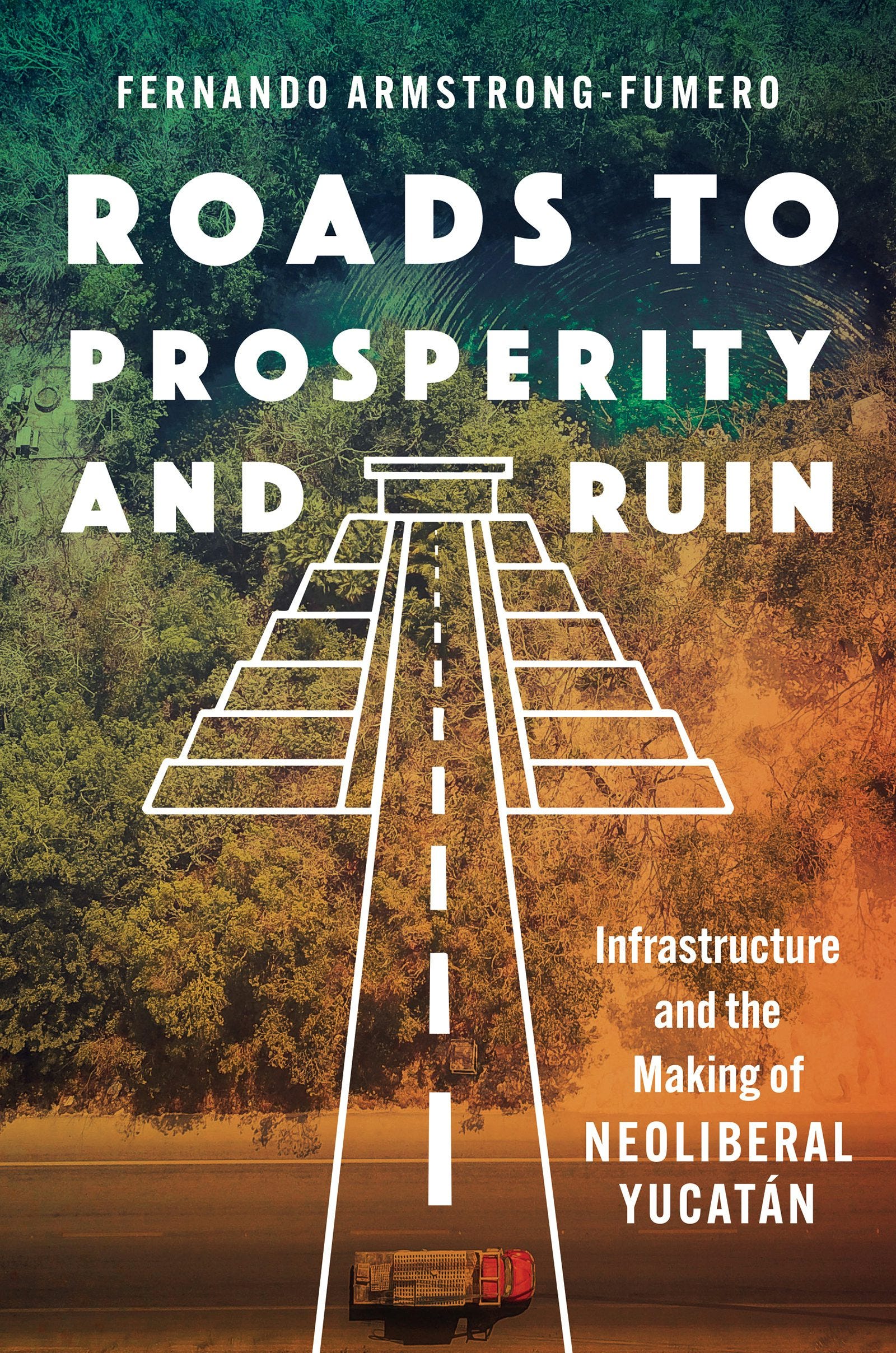
While neoliberalism is reflexively understood as a globalising project, anthropologists have long noted how its effects on the ground can be ambiguous and harder to define.
Mexico’s experience of neoliberalism reflects both David Harvey’s influential characterisation of it as a hegemonic global order in which the primary role of the state is to protect “strong private property rights, free markets, and free trade”.
Thus, the privatisations and free trade policies that have transformed Mexico’s economy and society since the 1980s were shaped by transnational political pressure, conditions set by international financial institutions, and the ideology of a generation of technocrats trained in elite US institutions—as well as their critics.
But as Fernando Armstrong-Fumero points out in this case study of infrastructure projects in the Yucatán, while this transnational vision provides a broad understanding of the dynamics of capital and the state, it can be less useful for explaining the realpolitik that shapes distinct experiences with neoliberalism on the ground.
Mexico’s very particular national experience has added layers of contextual meaning to the term “neoliberalism”, which has tended to refer to a national set of political actors and media narratives that emerged during a long period of crisis and reorganisation in the country.
The author’s focus is Pisté, a town of 6,000 predominantly Indigenous Maya residents in the state of Yucatán, which has been undergoing dramatic changes since 2022 as a result of the Tren Maya infrastructure project, a keystone of the presidency of Andrés Manuel López Obrador.
He identifies how, despite the turmoil of change brought by federal funding, the impact on established economic patterns, and the transformation of political party dynamics, local people have often tended to draw on older, pre-neoliberal strategies to negotiate their role in this drama.
Armstrong-Fumero seeks to identify how, in fact, older political tactics that emerged in the wake of infrastructural developments that began at the end of the 1930s continue to be relevant to local communities today, in spite of the changes that marked the neoliberal transition of the 1980s.
As he notes, a key insight that has emerged in contemporary political anthropology is that neoliberalisation has been experienced differently and is imagined in distinct ways at the different sites where it makes an impact.
He writes: “Insofar as different communities have experienced Mexico’s neoliberal era in different ways, they have created different symbolic orders to make national processes intelligible within local realities.
“That is, when rural Yucatecans interpret local experiences of life, labour and politics through the moral order of capitalism, they also place a distinctly local stamp on this hegemonic global system.”
Not only do many rural Mayan speakers frame their experience of economic development in ways that defy the expectations of both Mexican policymakers and scholars of Indigenous resistance—articulating a kind of “ethnic entrepreneurship”—they also continue to value institutions associated with the corporatist politics of the early twentieth century.
Armstrong-Fumero calls this “vernacular neoliberalism” and it is tied to the multigenerational experience of economic and social change in rural Yucatán associated over many decades with new poles of development such as the creation of Cancún.
He has written a detailed and important ethnographic study of the politics in a mainly indigenous region of the Tren Maya project itself and economic development in the Yucatán more broadly.
He concludes: “People in communities like Pisté don’t need to appeal to transnational solidarity, because they possess a number of well-worn local tools for political leverage … the structure of municipal governance assures that people like the residents of Pisté never entirely lacked leverage in electoral politics or through formal institutions like the ejido.
“Again, the aspirations and lived realities of people in these communities contradict academic narratives that tend to treat Indigenous people and other subaltern groups as being fundamentally alienated from the formal institutions of modern nation-states.”
*Please help the Latin American Review of Books: you can subscribe on Substack for just one month ($5) or, if you like what we do, you can make a donation through Stripe